Latitude: 50.6091 / 50°36'32"N
Longitude: -2.455 / 2°27'17"W
OS Eastings: 367901
OS Northings: 78920
OS Grid: SY679789
Mapcode National: GBR PY.DH3Z
Mapcode Global: FRA 57RG.7F3
Plus Code: 9C2VJG5W+J2
Entry Name: Head Post Office
Listing Date: 22 December 1997
Grade: II
Source: Historic England
Source ID: 1147967
English Heritage Legacy ID: 467935
ID on this website: 101147967
Location: Weymouth, Dorset, DT4
County: Dorset
Electoral Ward/Division: Melcombe Regis
Parish: Weymouth
Built-Up Area: Weymouth
Traditional County: Dorset
Lieutenancy Area (Ceremonial County): Dorset
Church of England Parish: Radipole and Melcombe Regis
Church of England Diocese: Salisbury
Tagged with: Post office
WEYMOUTH
SY6778NE ST THOMAS STREET 873-1/23/353 (West side) No.67 Head Post Office
GV II
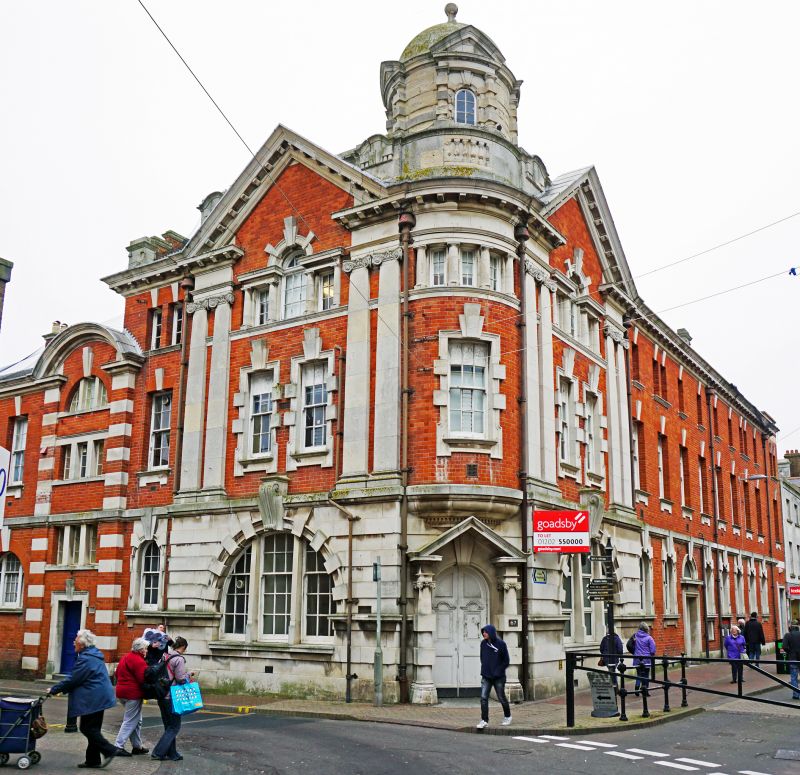
Head post office. Early C20. Flemish bond brickwork with Portland stone dressings, slate roof. A large block with long frontage to St Thomas Street, and a shorter return to Lower St Alban Street; the corner is taken on a quadrant with a cupola, flanked by high pedimented gables carried on giant paired Ionic pilasters. Robust Edwardian Baroque, reminiscent of Thomas Archer's work. EXTERIOR: 2 storeys. Windows are mainly glazing-bar sashes. The pedimented bays flanking the corner have a Palladian window above 2 deep sashes in architraves, with very deep triple keystones, and Gibbsian blocks. Ground floor, in banded ashlar, has a large lunette with triple light, bold scrolled keystone, and raised keystones to the architrave. Stone cupola with ball finial has 4 small arched lights under pediments, set to the curve, in banded ashlar above a blind balustrade. The moulded open pediments with guttae modillions are linked round the quadrant, with 3 small lights in Doric mullions below the architrave; a sill band threads the giant pilasters and reappears as sill band to the Palladian lights. At first floor is a single tall sash as to each side, and the doorway with open pediment on banded Ionic columns is set across the angle, with a pair of doors in an arch. Front to St Thomas Street has single and paired sashes in plain reveals, with deep keystones and moulded stone sills at second floor, plus stone aprons at first floor, and in arched moulded surrounds with keystones at ground floor; the arch keystones rise to a continuous plain stone band. In the third bay is a pair of panelled doors in a bolection-mould surround, under an entablature with small lunette over, and a further door and surround, with transom panel above, in the end bay to the right, which is slightly set back from the remainder. The return frontage is similar, but with lunette windows to the ground floor, and with an inserted bay to a segmental moulded head and banded pilasters, with a further doorway. A stone cornice to concealed eaves gutter. The end returns to a brick bay with 3 windows and a blocked doorway, then sets back to the rear of the main range, which is in painted brick with
simple detailing. INTERIOR: the principal office interior has been transformed in the late C20. A bold design which dominates a prominent corner position: it makes few concessions to the surroundings, but also takes the corner as a firm urban statement.
Listing NGR: SY6790478932
External links are from the relevant listing authority and, where applicable, Wikidata. Wikidata IDs may be related buildings as well as this specific building. If you want to add or update a link, you will need to do so by editing the Wikidata entry.


Other nearby listed buildings