Latitude: 53.4877 / 53°29'15"N
Longitude: -2.0898 / 2°5'23"W
OS Eastings: 394140
OS Northings: 398997
OS Grid: SJ941989
Mapcode National: GBR FXV3.CH
Mapcode Global: WHB9J.WL1N
Plus Code: 9C5VFWQ6+33
Entry Name: Church of St Michael and All Angels
Listing Date: 12 January 1967
Grade: I
Source: Historic England
Source ID: 1162800
English Heritage Legacy ID: 212681
Also known as: St Michael and All Angels Church, Ashton-under-Lyne
ID on this website: 101162800
Location: Church of St Michael and All Angels, Ashton-under-Lyne, Tameside, Greater Manchester, OL6
County: Tameside
Electoral Ward/Division: St Peter's
Parish: Non Civil Parish
Built-Up Area: Ashton-under-Lyne
Traditional County: Lancashire
Lieutenancy Area (Ceremonial County): Greater Manchester
Church of England Parish: Ashton-under-Lyne The Good Shepherd
Church of England Diocese: Manchester
Tagged with: Church building Gothic architecture
ASHTON-UNDER-LYNE STAMFORD STREET SJ 99 NW (south side)
4/32 Church of St. Michael and 12/01/67 All Angels
G.V. I
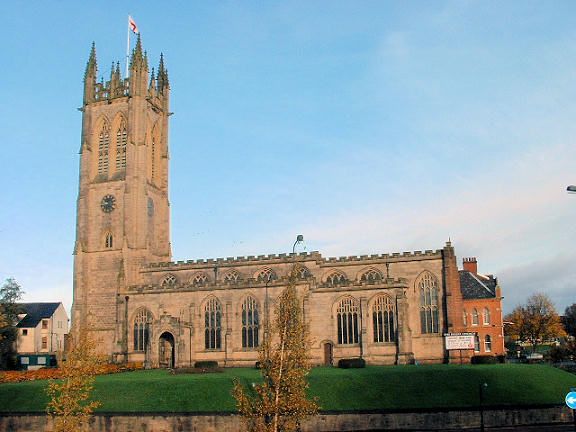
Church. The C15 church was virtually rebuilt in C19. North side 1821, nave and south side 1840-44, east wall of chancel 1883, tower 1886-8 by Crowther, north porch c.1920. Ashlar. 3-sided gallery housed within aisles; chancel and a west tower. Victorian Gothic; largely in a Perpendicular style. 5- bay nave and 3-bay chancel with weathered plinth, weathered buttresses and a castellated parapet which steps down to mark the chancel. 3 and 4-light transomed windows with interlaced tracery to the north aisle and clerestory and Perpendicular tracery elsewhere including the 7-light east window. Hoodmoulds have carved head stops, some on the south side dating from C15. North and south porches. Imposing 4- stage tower with set back and gableted buttresses topped by crocketed pinnacles, heavily moulded west door surround, 5- light window, clock in third stage and two 2-light belfry windows in each face. The castellations of the parapet are pierced and enriched. The C19 gritstone facing conceals parts of the medieval red sandstone walls. Interior: the arrangement is unusual in that only a fraction,of the chancel is taken by the sanctuary, there is no choir, and the seating, which spills over from the nave,faces west towards the 3-decker pulpit which is against the north arcade. The chancel is only defined by the chancel arch which bears the royal coat of arms and by a slight drop in ceiling level. The plastered ceiling beams are supported on cambered beams and have enriched and decoratively painted bosses and panels. The heavily moulded columns of the nave arcades support timber galleries part of which formed a chantry chapel in the C18. Apart from the arrangement, the most noticeable feature is the heavy decoration of stone and timberwork. The arcade spandrels, the chancel arch, the timber galleries, and many of the fittings are covered with intricate mouldings and blind arcading. Early stained glass of late C15 and early C16, now in the aisles, originally came from the east window. A total of 18 scenes depict the life of St. Helena, members of the Assheton family and 3 saintly kings. John Postlethwaite wall memorial, 1818 by T. McDermott. A noteworthy church most of which can be accredited to the 1840s, and yet not at all the ecclesiological arrangement or appearance one would expect for that date. W. M. Bowman, England in Ashton-under-Lyne, 1960. Stained glass - Transactions of the Lancashire and Cheshire Antiquarian Society, 1902.
Listing NGR: SJ9414198994
External links are from the relevant listing authority and, where applicable, Wikidata. Wikidata IDs may be related buildings as well as this specific building. If you want to add or update a link, you will need to do so by editing the Wikidata entry.


Other nearby listed buildings