Latitude: 50.5728 / 50°34'22"N
Longitude: -4.1888 / 4°11'19"W
OS Eastings: 245105
OS Northings: 77075
OS Grid: SX451770
Mapcode National: GBR NT.F9WT
Mapcode Global: FRA 273K.9XP
Plus Code: 9C2QHRF6+4F
Entry Name: Church of St Peter
Listing Date: 21 March 1967
Grade: II*
Source: Historic England
Source ID: 1171163
English Heritage Legacy ID: 93940
Also known as: St Peter's Church, Lamerton
ID on this website: 101171163
Location: St Peter's Church, Lamerton, West Devon, PL19
County: Devon
District: West Devon
Civil Parish: Lamerton
Built-Up Area: Lamerton
Traditional County: Devon
Lieutenancy Area (Ceremonial County): Devon
Tagged with: Church building
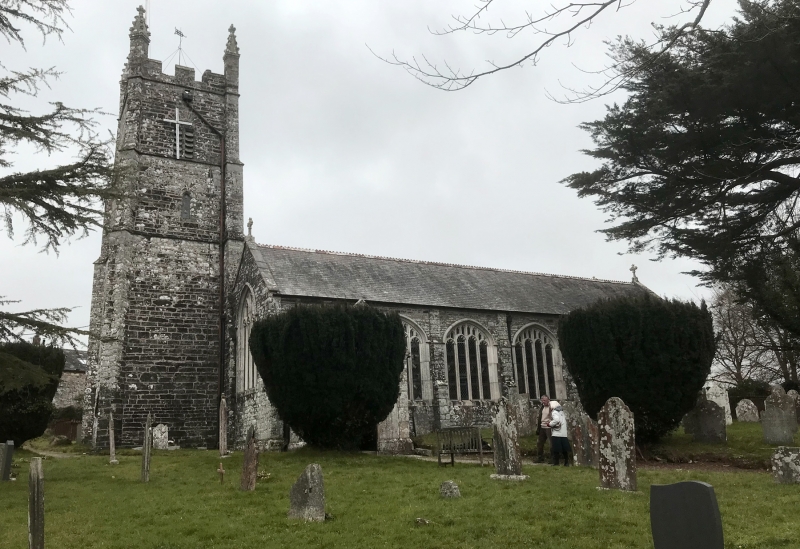
LAMERTON LAMERTON SX 47 NE 3/44 - Church of St Peter 21.3.67 GV II* Parish church. Late C14/early C15, porch sundial dated 1695, tower west door dated 1806, 1841 restored by Foster of Plymouth (DNCCP), church restored 1876 at cost of £1300, "the old barrel ceiling was removed and the oak beams of the chancel thrown open", new organ of 1876, 1877 church destroyed by fire, "the tower alone being saved" rebuilt after 1877. Mixed slatestone coursed rubble, squared granite porch, granite dressings, slate roofs with raised coped verges, crestings and cross finials. West tower, nave, north and south aisles, south porch, chancel. Mainly Perpendicular style of rebuilding. 3-stage tower has weathered diagonal buttresses, plinth moulded string courses, north east polygonal stair tower with lancets, embattled parapet over all with C19 crocketted pinnacles. West door with 2-centred arch chamfered and hollow-chamfered surround, hood-mould and relieving arch, C19 door with strap hinges, date 1806 and initials IL carved on jamb, 3-light pointed arched window above with cusped heads, hood-mould and relieving arch, second relieving arch above from former 2-light square-headed bell-opening with chamfered mullion, slate louvres and relieving arch. 5-bay north aisle has 4-light Perpendicular window to each bay with 4-centred arched heads, 2 central lights taller, cusped heads and hood-mould, weathered buttresses with undercut mouldings to set-offs, door to west with roll- moulded architrave, hood-mould with square-cut carved stops, door recessed with foliage in spandrels of 4-centred arch, plinth; to east, a 4-light window with Y- tracery, hood-mould and lancet above, polygonal stack. 5-bay south aisle has 4 similar windows to left, window to right of early construction, finer moulding to tracery, of 3 lights with taller central light, cusped heads and hood-mould, ogee- head priest's door below with hollow-chamfered and pyramid stopped surround; 4-light east window and lancet as on north aisle, similar 4-light west window and plinth. Gable porch in south west bay of south spandrels, square hood-mould with quatrefoils on stops, slate sundial with gnomon above, wrought iron gates; interior of porch has pitched slate floor, similar inner door opening, C19 door with strap hinges, no hood- mould, roof of principal rafters, arched braces, collars, collar purlin and wall plate. Chancel has 5-light east window with lattice transom, panel tracery and through reticulation, cusped heads, hood-mould and lancet above, plinth. Interior tower has deep splayed reveal to west window, ceiling in 9 panels, central one larger, floor as in porch, stone newel stair, Whitechapel bellframe and bells by John Warner and Son, London; pointed arched chamfered surround to C19 stair door with strap hinges, tall pointed tower arch with impost moulding. Nave have 6-bay arcade, some redressed shafts remaining, 4-centred arches with Pevsner.A-type piers with shaft rings to capitals and bases, 14-bay wagon roof extended over chancel with principal rafters, arched-braces, one row of purlings, collar and moulded collar purlin, wall plate and carved wooden bosses at intersections. North aisle has similar 12-bay roof, 4-centred arched chamfered surround to north door, deep roll- moulding to surrounds of windows, east end used as organ chamber and vestry; south aisle has similar roof, flat head to priest's door. Chancel has 2 sedilia and piscina to south east with ogee hood, cusped openings, finials and crocketed pinnacles, much restored limestone; C19 tiled reredos. Fittings: C19 pews and pulpit; carved wood painted Royal Arms of George III in north aisle; organ by J.W. Walker and Sons, London, 1880; C19 octagonal granite font in nave with octagonal stem and carved sides. Monuments in north aisle: stone tablet with draped urn, to John Bennett, 1822, by J. Hooper of Plymouth; marble tablet to William Weeks, 1829, by Bovey and Co, Plymouth; stone monument with demi-figures of man and wife in 2 recessed niches with broken scrolled pediment and shield over, inscription panel with verse, scrolls and shield below, to Hugh Fortescue, 1650 and his wife Elizabeth. In south aisle: oval stone table to Arthur Tremayne, 1808; marble tablet to Rev. William Cowlard, 1844, by Bovey and Co; Tremayne family monument, dated 1588 and rebuilt by Arthur Tremayne, 1707, has marble Corinthian columns on plinths with Tremayne shields, inscription panel below with large shield to each side, plinth with 5 figures, 2 in armour and 3 civilians, 3 panels above with verses on Tremayne family, border with carved foliage and flowers, surmounted by segmental pediment with heads of putti, flowers and shields in tympanum, 2 reclining angels with trumpets gilded bove and shields. Chancel east window and 2 windows in north aisle have stained glass with late C19 scenes from the life of Christ. (Sources: Pevsner, N.: Buildings of England: South Devon 1952. White: History, Gazetteer and Directory of the County of Devon 1878-9. Devon Nineteenth Century Churches Project).
Listing NGR: SX4510577075
External links are from the relevant listing authority and, where applicable, Wikidata. Wikidata IDs may be related buildings as well as this specific building. If you want to add or update a link, you will need to do so by editing the Wikidata entry.


Other nearby listed buildings