Latitude: 54.6669 / 54°40'0"N
Longitude: -1.6699 / 1°40'11"W
OS Eastings: 421387
OS Northings: 530250
OS Grid: NZ213302
Mapcode National: GBR JGSG.8V
Mapcode Global: WHC52.BY1P
Plus Code: 9C6WM88J+Q2
Entry Name: Chapel of St Peter at Auckland Castle
Listing Date: 21 April 1952
Grade: I
Source: Historic England
Source ID: 1196446
English Heritage Legacy ID: 385601
Also known as: St Peter's Chapel, Auckland Castle
ID on this website: 101196446
Location: Bishop Auckland, County Durham, DL14
County: County Durham
Civil Parish: Bishop Auckland
Built-Up Area: Bishop Auckland
Traditional County: Durham
Lieutenancy Area (Ceremonial County): County Durham
Church of England Parish: Bishop Auckland
Church of England Diocese: Durham
Tagged with: Chapel
BISHOP AUCKLAND
NZ2130 AUCKLAND CASTLE PARK 634-1/8/84 (East side (off)) 21/04/52 Chapel of St Peter at Auckland Castle
GV I
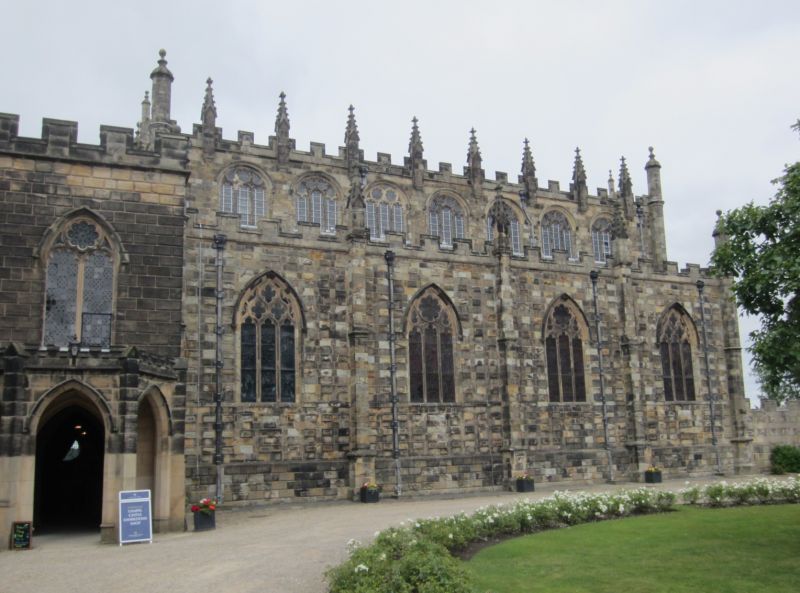
Domestic aisled hall, later chapel, with terrace and steps. c1190. For Bishop du Puiset (on stylistic evidence), possibly on foundations of earlier hall, completed by 1249. Aisle walls probably raised by Bishop Bek (1284-1311) replacing smaller gables. Conversion to chapel including rebuilding south wall, renewing clerestory, and refacing east and west walls, 1661-5 for Bishop Cosin. Craftsmen John Langestaffe mason, Marke Todd and James Hulle, joiners, Abraham Smith, John Brasse and Richard Herring, carpenters and carvers (Raine, Boyle). Aisle floors raised to level of nave, and chapel refloored, for Bishop van Mildert in 1827. Further restorations for Bishop Lightfoot, and 1978-83 for the Church Commissioners. MATERIALS: rusticated ashlar, coursed squared stone north wall, roof not visible. PLAN: chapel has 4-bay aisled nave and chancel with screen, to west full-width vestibule. South porch to west entrance passage and robing room. EXTERIOR: east elevation has tall 5-light window with geometric tracery, and 2-light aisle windows with trefoil heads. Below windows blocked arches and relieving arch are vestiges of screens passage of former hall. In first bay of north wall a similar arch under the window is also blocked and was part of the domestic hall arrangements. South elevation refaced for Cosin has rich rustication, much with lozenge jewels. 3-light aisle windows have reticulated and decorated tracery. 7 clerestory windows probably for Cosin, with segmental heads and modified geometric tracery. Tall pinnacled buttresses, at aisle and clerestory angles polygonal with ogee coping. Crocketed pinnacles corbelled between clerestory lights. West gable has tall 4-light window with reticulated tracery, and at top a well-cut inscription ADORATE DOMINUM IN ATRIO SANCTO EIUS and Cosin's arms above. All parapets battlemented. South-east entrance projects with canted arcaded C18 Gothic porch below 2-light window under battlemented parapet. In porch, richly carved C17 doors. Terrace wall and steps at east end. Shallow stone L-plan steps flank wall with ashlar coping, the end sections forming parapets to steps. At centre, one 1881 inscription recording Bishop Lightfoot's work and his setting up of the second inscription, dated 1752 `JOSEPHUS EPISCOPUS FECIT' must relate to work done by Bishop Butler who began major improvements to the grounds. INTERIOR has black and white marble floor, 4-bay arcades, west screen, and panelled beamed roof on arched braces and corbelled wall posts. Arcades have many-moulded pointed arches on quatrefoil piers with shaft rings, north and south shafts sandstone, east and west shafts Frosterley limestone which is also used for capitals and arches. Central bays are shorter. West responds are head corbels, and capitals waterleaf, the southern more elaborate; others moulded. Round lessenes above piers support large figures of angels. In west wall 3 arches of a blind arcade with stiff leaf decoration, discovered in 1980s restoration, have been left exposed; this was the dais end of the hall. In north aisle western bay a pointed arch is also revealed, with stiff leaf capital. 3 steps to altar with carved Frosterley limestone and oak reredos 1884 by Hodgson Fowler in Perpendicular style, carving by P de Wispelaere of Bruges. Woodwork for Cosin in his typical style, mixing Gothic and Baroque, includes pulpit and reading desk, chancel stalls with principal canopies, and magnificent carved oak screen with swags of fruit and foliage. MONUMENTS include Frosterley marble grave cover in centre of nave with long inscription to Bishop Cosin; seated figure of Bishop Trevor 1775 by Nollekens. Ceiling richly carved and painted with armorial bearings especially those of Bishop Cosin. C19 armorial bearings of Bishops set on aisle walls. Stained glass mostly by Burlison and Grylls. In west entrance vestibule, arms of Bishop Cosin in stained glass. (Raine J: History of Auckland Castle: Durham: 1852-: 45; Medieval Architecture and its Intellectual Context: Cunningham J: Auckland Castle: Some Recent Discoveries: London: 1990-: 81-90; Mackenzie E: County Palatine of Durham: Newcastle: 1834-: 294; Archaeologia Aeliana series 2: Hodgson J F: Article VIII The Chapel of Auckland Castle (for 1896): Newcastle upon Tyne: 1847-: 113-240; Archaeologia Aeliana series 2: Hodgson J F: Article VI The Chapel of Auckland Castle - Addenda (for 1897): Newcastle upon Tyne: 1847-: 113-240; Boyle: The County of Durham: 1892-: 483-497).
Listing NGR: NZ2138430248
External links are from the relevant listing authority and, where applicable, Wikidata. Wikidata IDs may be related buildings as well as this specific building. If you want to add or update a link, you will need to do so by editing the Wikidata entry.


Other nearby listed buildings