Latitude: 53.012 / 53°0'43"N
Longitude: -1.1579 / 1°9'28"W
OS Eastings: 456593
OS Northings: 346410
OS Grid: SK565464
Mapcode National: GBR LM0.DF
Mapcode Global: WHDGL.5KV8
Plus Code: 9C5W2R6R+RR
Entry Name: Lych gate at Emmanuel Church
Listing Date: 27 April 1987
Last Amended: 10 June 2025
Grade: II
Source: Historic England
Source ID: 1227459
English Heritage Legacy ID: 425240
ID on this website: 101227459
Location: Top Valley, Gedling, Nottinghamshire, NG5
County: Nottinghamshire
District: Gedling
Civil Parish: Bestwood St. Albans
Built-Up Area: Nottingham
Traditional County: Nottinghamshire
Lieutenancy Area (Ceremonial County): Nottinghamshire
Church of England Parish: Bestwood Emmanuel
Church of England Diocese: Southwell and Nottingham
Tagged with: Lychgate
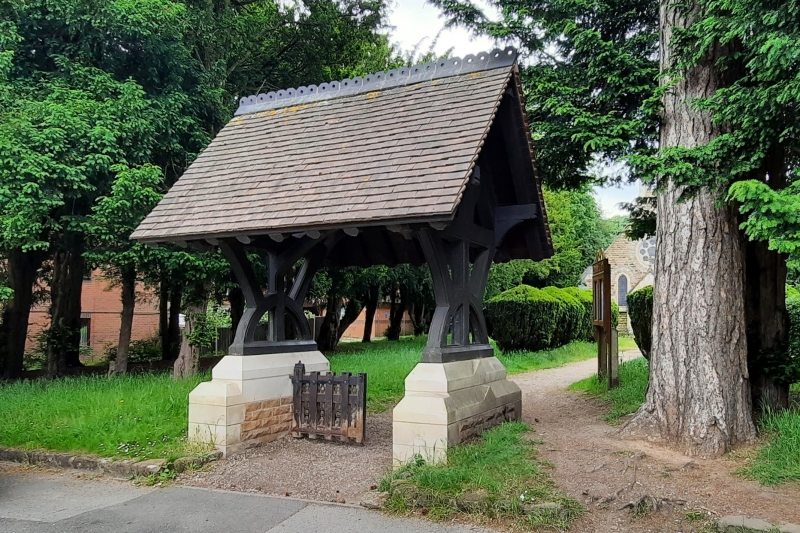
Lych gate at Emmanuel Church. Built in the mid-19th century by the architect, S S Teulon. The lych gate was relocated to the west end of the church yard in 2009.
MATERIALS: the lych gate is built of Ancaster and Bulwell stone and Oak timber under a clay tile roof.
PLAN: the lych gate stands at the western entrance of the churchyard.
DESCRIPTION: the lych gate is a gabled structure with roof ridge running at a right angle to the frontage. The wooden gates are centrally hung between the stone end walls and are decorated with crenellated posts and metal work fittings. The end walls are of rusticated Bulwell stone with dressed Ancaster stone quoins and two tiers of Ancaster stone chamfered coping. The walls support the oak timber framing consisting of chamfered wooden bases with moulded posts and double arch braces. King posts rise above the collar beam with purlins with moulded ends. The roof is covered in hand made clay tiles with decorative ridge tiles.
Lych gates are the ornamental and often picturesque gateways which lead to churchyards, and which possess a symbolic importance as the thresholds between the secular and sacred zones of a parish. Medieval lych gates were used as a meeting point and shelter for burial parties bringing bodies for interment. The group would convene beneath the lych gate, to be met by the priest prior to entering the consecrated churchyard and beginning funerary rituals. Some lych gates had a slab or rest to hold the coffin, and they often had benches inside. Their name derives from the Anglo-Saxon or German word for corpse: lich, or leiche. Lych gates continued to be built throughout the C19 and C20, and later examples, particularly after the First World War, were often erected as memorial structures.
Emmanuel Church Bestwood (Grade II*, National Heritage List for England(NHLE) entry 1235441) was built as an estate church for the 10th Duke of St. Albans to provide a place of worship for his family and the growing congregation around the Bestwood Lodge estate. It was built between 1868 and 1869 by the architect, S. S. Teulon whose previous work on the estate in the 1860s includes Bestwood Lodge (Grade II*, NHLE entry 1227444), stables (Grade II, NHLE entry 1265261), bakery (Grade II, NHLE entry 1227445), garden walls and gateway (Grade II, NHLE entry 1265367), and Alexandra Lodge (Grade II, NHLE entry 1227457). The lych gate is believed to date to mid-C19, and it is probable that Teulon was also the architect responsible for its design and construction.
The lych gate was originally located at the south-east end of the church yard, the historic entrance to the site, facing the footpath towards Bestwood Lodge. In 2009, following restoration work, the oak frame and gates were relocated to the west end of the church yard, now the main entrance to the grounds, and new Ancaster and Bulwell stone walls were constructed. The original York stone paving and steps, along with the Ancaster and Bulwell stone walls remain in situ. The steps have since been covered over with slab paving to form a ramp.
The lych gate at Emmanuel Church is listed at Grade II for the following principal reasons:
Architectural interest:
* a good-quality design in the Gothic Revival style. The lych gate forms a picturesque entrance to the churchyard
Historic interest:
* it has strong historic interest for its design by the architect S S Teulon.
Group value:
* the lych gate has good group value with the Grade II* listed church.
External links are from the relevant listing authority and, where applicable, Wikidata. Wikidata IDs may be related buildings as well as this specific building. If you want to add or update a link, you will need to do so by editing the Wikidata entry.


Other nearby listed buildings