Latitude: 53.6817 / 53°40'53"N
Longitude: -1.5043 / 1°30'15"W
OS Eastings: 432836
OS Northings: 420691
OS Grid: SE328206
Mapcode National: GBR KTYV.3Y
Mapcode Global: WHC9Z.VQTF
Plus Code: 9C5WMFJW+M7
Entry Name: Pemberton House
Listing Date: 20 January 1975
Grade: II
Source: Historic England
Source ID: 1258908
English Heritage Legacy ID: 445836
ID on this website: 101258908
Location: Brooks Bank, Wakefield, West Yorkshire, WF1
County: Wakefield
Electoral Ward/Division: Wakefield North
Parish: Non Civil Parish
Built-Up Area: Wakefield
Traditional County: Yorkshire
Lieutenancy Area (Ceremonial County): West Yorkshire
Church of England Parish: Wakefield All Saints
Church of England Diocese: Leeds
Tagged with: House
This list entry was subjected to a Minor Enhancement on 2 April 2024 to amend details in the description, add Historical note and source and reformat the text to current standards
SE 3220 NE
1/310
WESTGATE (North Side)
No 122 (Pemberton House)
20.1.75.
II
Large house, mid-C18 for Pemberton Milnes, refenestrated in the early C19.
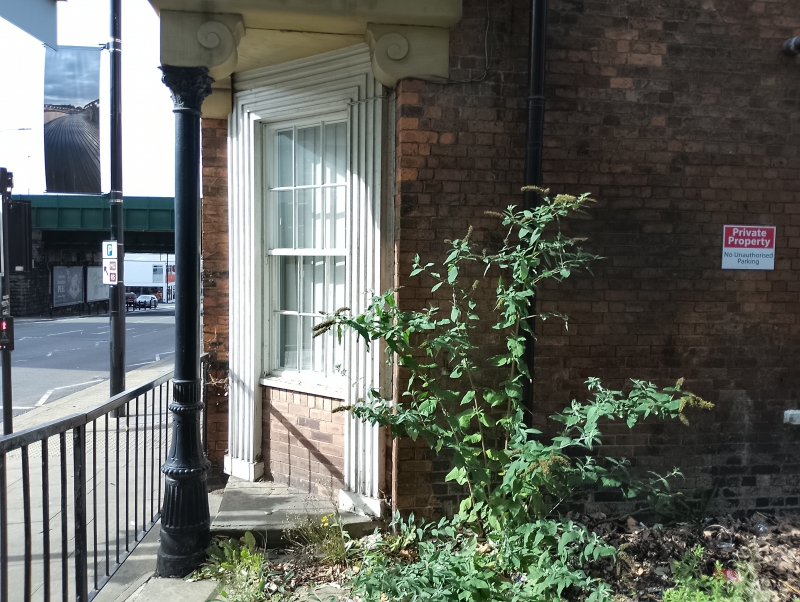
Built of light-coloured red brick of three storeys with five bays facing Westgate to the south-east, the other facades being irregular. Windows are generally sashes with delicate glazing bars set in openings with cambered arches and stone cills. The ground-floor eastern corner is cut away (for a former corner-set doorway inserted in the late C19), with a cast iron column inserted for support. On the north-eastern elevation there is a C19 six-panel door set in a stone architrave with scrolled consoles supporting a pediment. The roof is fairly high-pitched and slightly swept, covered with stone slates. To the eaves of the Westgate elevation is a later moulded timber cornice.
Listing NGR: SE3283620691
Westgate was one of Wakefield’s four principal medieval streets. During the C17 and C18 this became a popular residential district for the mercantile classes. Pemberton Milnes (1729-1795), with his elder brother Robert, ran one of the largest cloth exporting businesses in the country, along with other concerns such as the importation of Baltic timber. Pemberton Milnes also developed an interest in building and brick making, with brick kilns near Wakefield. Pemberton House was possibly built in 1753 or 1754 by his elder brother Robert, ownership being transferred to Pemberton in 1755. In 1754 Pemberton married Jane Slater, the elder sister of Robert’s wife. This was two years after Pemberton had been a major funder for the construction of the adjacent Westgate Chapel.
From the 1770s, with his considerable wealth and contacts, and spurred on by independent thinking aided by his Nonconformist faith, he asserted considerable influence over politics in Yorkshire and beyond via his friendship with the second Marquess of Rockingham. Despite being a Nonconformist, he became a magistrate and a deputy lieutenant for the West Riding. In 1779 he was one of the founding committee members of the Yorkshire Association, the same year he bought into the landed gentry with his purchase of Bawtry Hall near Doncaster. Pemberton House remained in the Milnes family until 1842. In 1810 it was owned by his only daughter Bridget, Dowager Viscountess of Gallway, who is thought to have commissioned Milnes Orangery in what was originally a part of the gardens to Pemberton House. Residential use is thought to have ended in the mid-C19 when it was compulsory purchased as part of the construction of the railway line, being subsequently used for offices including the Wakefield and West Riding Herald newspaper (1872-1910), Wakefield’s Labour Exchange (1920-1946) and British Rail until the early 1970s.
External links are from the relevant listing authority and, where applicable, Wikidata. Wikidata IDs may be related buildings as well as this specific building. If you want to add or update a link, you will need to do so by editing the Wikidata entry.


Other nearby listed buildings