Latitude: 50.8896 / 50°53'22"N
Longitude: -3.2644 / 3°15'51"W
OS Eastings: 311159
OS Northings: 110774
OS Grid: ST111107
Mapcode National: GBR LT.S8SJ
Mapcode Global: FRA 461R.B22
Plus Code: 9C2RVPQP+R6
Entry Name: Lower Leigh Farmhouse
Listing Date: 5 April 1966
Grade: II
Source: Historic England
Source ID: 1325847
English Heritage Legacy ID: 95790
ID on this website: 101325847
Location: Bodmiscombe, Mid Devon, EX15
County: Devon
District: Mid Devon
Civil Parish: Uffculme
Traditional County: Devon
Lieutenancy Area (Ceremonial County): Devon
Church of England Parish: Uffculme St Mary Virgin
Church of England Diocese: Exeter
Tagged with: Farmhouse
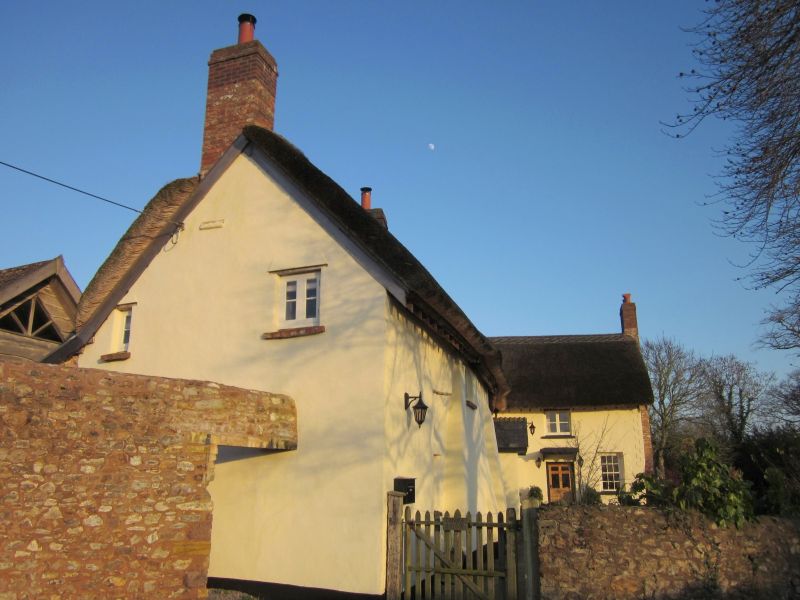
ST 11 SW UFFCULME 5/135 Lower Leigh Farmhouse 5.4.66 - II Detached house, formerly a farmhouse. Possibly a C17 remodelling of an earlier house, extended and refurbished in circa 1700, and again in the 1830s. Roughcast cob and stone mix; gable end roof, thatched to front, pantiled to rear; pantiled continuous outshut, largely of stone. Plan: a puzzling house. Originally probably a 3-room, through-passage plan house, the service end to the left of the passage. The roof has been almost entirely rebuilt since the war, and the only early truss surviving is unlikely to pre-date the late C17. However, the stack (now partially dismantled) gives every impression of having been inserted into the passage, so that the present entrance leads into a lobby, with a very narrow passage running behind the stack. An extension to the service end was added, slightly out of alignment with the main range, and heated by an internal end stack with bake oven. The original service end is heated by a deep stone (formerly end) stack, also with bake oven, and with a recess for either winder stairs or a smoking chamber. The hall presents several problems: the first floor looks C18, and is at 2 levels, taller immediately forward of the fireplace then at the higher end, a feature that forms a platform in the chamber above, about 48' square, and 2' high. Its function is uncertain, but it creates 2 distinct spaces in both rooms, probably reflecting different activities taking place in structurally undivided rooms. C18 stairs have been inserted along the front face of the hall, which are lit by a pair of contemporary pegged 2-light casement windows which, externally, give the impression of being one tall window. A wing built to the front of the inner room and heated by an external end stack, retains some mid C17 wall decoration in the upper chamber, contemporary or a little earlier than the C17 joinery elsewhere. In circa 1831 (the date of an object found in the wall) a wing was added to the rear of the inner room; it is wider than the front wing, allowing for an axial corridor running along the lower-end side, which gives access to the principal 1830 room from the old hall, by way of a short but elegant flight of stairs - a satisfying and imaginative piece of design. 2 storeys. Exterior: front: a real jumble; the paired casement windows to hall and hall chamber (described above) to the right of a C19 timber porch with boarded gable; to the left of the porch is an early tall C19 round-headed 2-light window, with decorative glazing bars in the head; the lower part of this window has been renewed, or extended, and it now straddles both floors. Left of this two large buttresses, one of which partially conceals a piece of rusticated quoining; 3-light casement window to service end chamber, set in a slightly projecting stretch of walling. 3-light casement window to service-room extension, ground floor. Front wing: one 2-light casement window to first floor inner face; C19 door flanked by 12-pane hornless sash windows to ground floor. Front angles in rusticated quoining. Outer face of wing with 2 late C18 pegged 2-light casement windows, with a large 16- pane hornless sash window lighting principal room of rear wing. The rear of the axial corridor of this wing is lit by a round-headed sash window. C19 casements elsewhere. Interior: (1) mid C17 mural decoration survives (apparently largely intact) under later panelling in the front wing chamber; where revealed it is made up of formal floral patterning with a series of associated arcs. (2) Much joinery of circa 1700, mainly large fielded panelled doors, including doors of wall cupboards, some with brass H-hinges. (3) Ceiling beams, where exposed, have very shallow chambers or bead mouldings, and look C18. (4) Some attractive early C19 joinery including the stairs to the rear of the hall with ramped rails and turned newels: fielded panel doors, and in the principal room of the rear wing, internal panelled sliding shutters; panelling elsewhere.
Listing NGR: ST1115910774
External links are from the relevant listing authority and, where applicable, Wikidata. Wikidata IDs may be related buildings as well as this specific building. If you want to add or update a link, you will need to do so by editing the Wikidata entry.


Other nearby listed buildings