Latitude: 53.1697 / 53°10'10"N
Longitude: -2.203 / 2°12'10"W
OS Eastings: 386525
OS Northings: 363642
OS Grid: SJ865636
Mapcode National: GBR 12C.7VT
Mapcode Global: WHBC1.4L6C
Plus Code: 9C5V5Q9W+VQ
Entry Name: Flint Mill (Central Part of Higher Washford Mill)
Listing Date: 4 April 1975
Grade: II
Source: Historic England
Source ID: 1330335
English Heritage Legacy ID: 55948
Also known as: Flint Mill, Upper Washford Mill
ID on this website: 101330335
Location: Lower Heath, Cheshire East, Cheshire, CW12
County: Cheshire East
Civil Parish: Congleton
Built-Up Area: Congleton
Traditional County: Cheshire
Lieutenancy Area (Ceremonial County): Cheshire
Church of England Parish: Congleton Team
Church of England Diocese: Chester
Tagged with: Mill Grinding mill Spinning mill
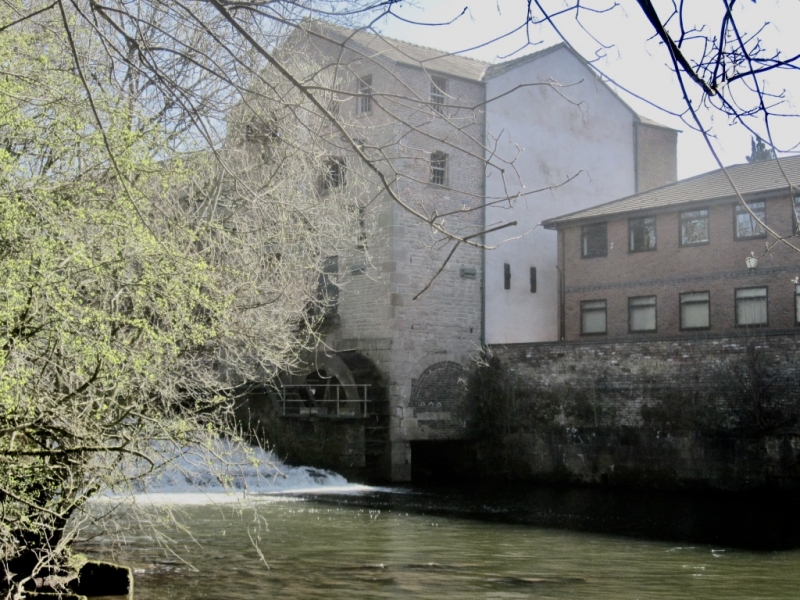
1 5144 MILL STREET Buglawton SJ 86 SE SP/476 Flint Mill (central part of Higher Washford Mill) II 2. Perhaps originally a corn mill, later a silk mill, now a flint grinding mill (disused): late C18, extended in early and mid C19 with late C19 and earlier C20 machinery. Dressed coursed pink sandstone and English garden wall bond brick. Welsh slate roof. Square in plan. 3-storey and attic, 2-bay north river front. Stone ground storey stands on a base of large blocks and carries a breast shot cast-iron bucket waterwheel of c.18 ft diameter. To the left and on either side are segmentally arched openings to the original wheelpit now containing cast-iron gearing, controls and a 10 hp Gilkes water turbine of 1935. An informal wooden stair leads to a door in the ground storey and a large small pane window with wedged lintel. 2 similar windows in first floor of brick with stone quoins. Top storey all in brick has a line of 16-pane sashes with wedged stone lintels. South entrance front is similar with wooden stair to raised original doorway and an inserted loading bay. There are long wings to either side of former textile mills of no special interest. Interior: Floors of heavy wooden cross beams. Ground storey contains a complete set of flint grinding machinery, working commercially until 1958 and last operated in 1975. Principal items are a circular grinding pan of riveted iron sheets and with wooden paddles, driven by the wheel, wash tub of similar construction, and ball clay mill driven by the turbine. Small hoists and tubs on rails also survive. The drive was formerly carried to the upper storeys and into the adjacent mills for working textile machinery. The mill is first mentioned in Directories in 1828 when it housed a silk throw- sters. In 1864 it was occupied by William Webberly, flint, stone and bone grinder and in 1883 by Ford and Son, Potters Material Manufacturer.
Listing NGR: SJ8652563642
External links are from the relevant listing authority and, where applicable, Wikidata. Wikidata IDs may be related buildings as well as this specific building. If you want to add or update a link, you will need to do so by editing the Wikidata entry.


Other nearby listed buildings