Latitude: 52.1908 / 52°11'26"N
Longitude: -2.227 / 2°13'37"W
OS Eastings: 384575
OS Northings: 254756
OS Grid: SO845547
Mapcode National: GBR 1G4.MSB
Mapcode Global: VH92T.C60B
Plus Code: 9C4V5QRF+85
Entry Name: Electricity Junction Box, Hylton Road
Listing Date: 31 January 2025
Grade: II
Source: Historic England
Source ID: 1492092
ID on this website: 101492092
County: Worcestershire
District: Worcester
Electoral Ward/Division: Bedwardine
Parish: Non Civil Parish
Built-Up Area: Powick
Traditional County: Worcestershire
Lieutenancy Area (Ceremonial County): Worcestershire
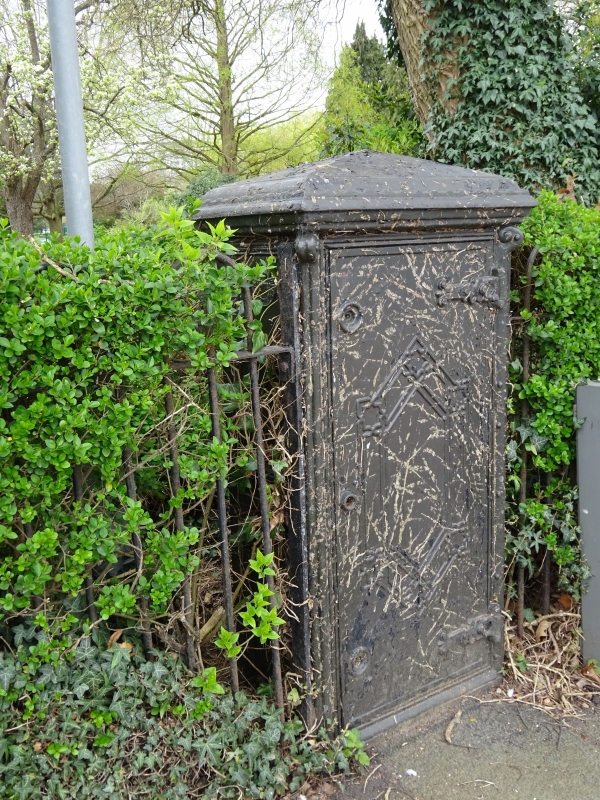
An electricity junction box of the early C20, manufactured by Hardy and Padmore of Worcester.
An electricity junction box of the early C20, manufactured by Hardy and Padmore of Worcester.
MATERIALS AND PLAN: the junction box is constructed of cast-iron and is square on plan.
DESCRIPTION: the electricity junction box is located on the north-eastern corner of Cripplegate Park and is situated between the railings and brick pillar, forming part of the boundary to the park.
The junction box has a low pyramidal cap with castellated edges above a moulded cornice. There are two main elevations, both with doors, accessible from both Hylton Road and from within Cripplegate Park. The doors have moulded surrounds, and feature a Jacobean-style geometric strapwork relief and decorative strap hinges at the right hand side. The two sides are plain with moulded edges and each have a circular relief reading ‘Hardy and Padmore Limited, Worcester’. The box is painted black.
This list entry was subject to a Minor Amendment on 17 December 2025 to correct spelling in address.
Electrical junction boxes were introduced across England from the late C19 and were part of the distribution and supply infrastructure needed to transfer electricity from where it was generated to its point of use. The junction box, or feeder pillar, was designed to take power from the grid and control the electrical supply to a number of buildings in the surrounding area.
In 1901, the Worcester Tramways Act authorised the expansion and electrification of the tram network. At this point, the British Electric Traction Co, of which the Worcester Electric Traction Co was a subsidiary, acquired the Worcester Tramways Company in 1902. In the same year, the Corporation of Worcester established a steam-driven electricity plant on Hylton Road. A junction box was installed at Hylton Road likely around this time. The trams then ran under this system until 1928, when the services were replaced by omnibuses.
The Hylton Road junction box is the work of Hardy and Padmore, whose foundry was based in Worcester. Robert and John Hardy set up their business in 1814 and Richard Padmore joined the partnership in 1829. The foundry was an important English producer of goods for worldwide distribution, including lamp posts, tram wire supports and poles, bollards, thresholds and manhole covers. Hardy and Padmore went into voluntary liquidation in 1967. A number of their products are listed including several gas lamps, and examples of feeder pillars on Library Walk and in Lincoln Square, Manchester (National Heritage List for England (NHLE) entries 1449639, 1475459, 1475254 and 1475255). Another listed feeder pillar is located within the suburb of Hornsey, London (NHLE entry 1359591).
The electricity junction box on Hylton Road is listed at Grade II for the following principal reasons:
Architectural interest:
* for the well-detailed design by Hardy and Padmore of Worcester, which demonstrates the consideration given to electricity infrastructure in the early-C20.
Historic interest:
* as an important survival of early-C20 electrical infrastructure, illustrating the first age of electrical supply.


Other nearby listed buildings