Latitude: 53.7927 / 53°47'33"N
Longitude: -2.2399 / 2°14'23"W
OS Eastings: 384296
OS Northings: 432957
OS Grid: SD842329
Mapcode National: GBR DSSL.W5
Mapcode Global: WHB7X.KXMT
Plus Code: 9C5VQQV6+33
Entry Name: Church of St Peter
Listing Date: 10 November 1951
Grade: II*
Source: Historic England
Source ID: 1022640
English Heritage Legacy ID: 467011
ID on this website: 101022640
Location: Burnley, Lancashire, BB11
County: Lancashire
District: Burnley
Electoral Ward/Division: Bank Hall
Parish: Non Civil Parish
Built-Up Area: Burnley
Traditional County: Lancashire
Lieutenancy Area (Ceremonial County): Lancashire
Church of England Parish: Burnley St Peter
Church of England Diocese: Blackburn
Tagged with: Church building
BURNLEY
SD8432NW CHURCH STREET 906-1/16/30 (West side) 10/11/51 Church of St Peter
GV II*
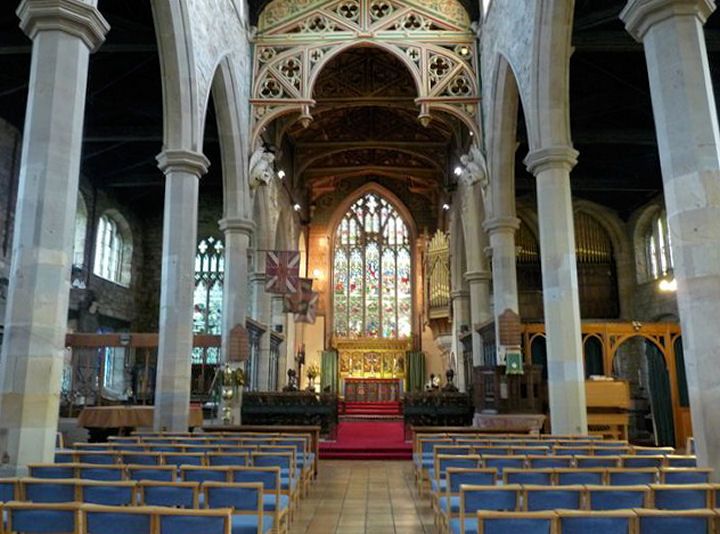
Parish church. C15 west tower (raised 1802), nave and north aisle rebuilt c1532, south aisle rebuilt in 1789-91 and north aisle again rebuilt in 1802 (both with galleries); nave raised 1854-6; sanctuary enlarged 1872-3; south porch added 1889; south-east vestry added and galleries removed 1903; major structural repairs in progress at time of survey 1991. Sandstone ashlar, slate roofs. Perpendicular style. EXTERIOR: the west tower, of 4 unequal stages with a massive moulded plinth, angle-buttresses to half-height, a drip-band over the 3rd stage, a set-back 4th stage with a corbel table, plain cornice and embattled parapet with intermediate and corner pinnacles, and an elaborate weather vane, has: a 2-centred arched west doorway with hollow-moulded surround, hood-mould with figured stops (worn) and double doors with scrolled strap hinges; a restored 3-light west window with cusped lights, Perpendicular tracery and a hood-mould; a similar but smaller 2-light window to the 3rd stage; clock faces in the top stage with small 2-centred arched one-light belfry windows above; and at the south-east corner a narrow rectangular vice (or stair-turret) which has small chamfered loop-lights. The narrow 5-bay nave (of the same width as the tower) has a clerestory of square-headed 4-light Tudor-style mullioned windows and an embattled parapet with large crocketed corner pinnacles. Both aisles extend eastwards alongside the chancel but are of unequal width and length, the narrower north aisle having a westward extension embracing the tower, but they are in matching style with 2-storeyed chamfered Tudor arches containing 4-light mullioned windows on both floors, those at 1st floor arched, and all with uncusped round-headed lights and hollow spandrels; the south aisle has pilaster-buttresses, a gabled Gothic porch to the 2nd bay and over this a large ogee-headed stone plaque with the date "1799[?]" inscribed above it, and between the 4th and 5th bays a large wall sundial inscribed "This Dial was constructed by / Mr Whyman of Gawthorpe / in the year 1791"; the buttressed north aisle has in the 2nd bay an ogee-headed doorway with plain surround, and its westward extension has a 4-light window at 1st floor only. The chancel has a large 2-centred arched 5-light east window with Perpendicular tracery.
INTERIOR: inaccessible because of repair work in progress. (Bennett W: The History of Burnley: Burnley: 1946-1951).
Listing NGR: SD8429632957
External links are from the relevant listing authority and, where applicable, Wikidata. Wikidata IDs may be related buildings as well as this specific building. If you want to add or update a link, you will need to do so by editing the Wikidata entry.


Other nearby listed buildings