Latitude: 51.7884 / 51°47'18"N
Longitude: -1.6783 / 1°40'41"W
OS Eastings: 422284
OS Northings: 210021
OS Grid: SP222100
Mapcode National: GBR 5T0.VXQ
Mapcode Global: VHBZY.V9LV
Plus Code: 9C3WQ8QC+9M
Entry Name: The Old Rectory
Listing Date: 12 September 1955
Grade: II*
Source: Historic England
Source ID: 1065936
English Heritage Legacy ID: 422422
ID on this website: 101065936
Location: Westwell, West Oxfordshire, OX18
County: Oxfordshire
District: West Oxfordshire
Civil Parish: Westwell
Traditional County: Oxfordshire
Lieutenancy Area (Ceremonial County): Oxfordshire
Church of England Parish: Westwell
Church of England Diocese: Oxford
Tagged with: Clergy house
WESTWELL SP21SW The Old Rectory 1/307 12.9.55 GV II*
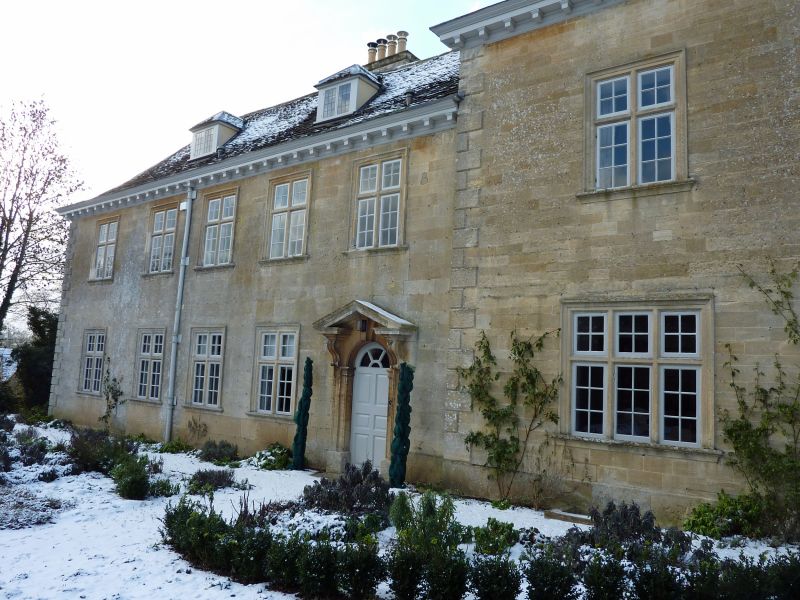
Parsonage house. c.1700, extended c.1847 and later. The older front is in freestone the newer in cut and squared rubble; wooden modillion eaves cornice; hipped Cotswold stone roof. Residual cross-passage plan from pre - 1700 house. L-shaped; the taller right hand gabled wing is an addition, it dates from c.1847 and matches the c.1700 block in details to front. Large ashlar off-ridge chimneys. 2 storeys and attics, chamfered quoins 2:1 hipped dormers with leaded lights. 5:1 windows with bull-nose cills, moulded architraves and cross mullions with edge hollow chamfers, some indication that the central ground floor window may have been a doorway. Arched doorway to right of main block with panelled piers to brackets, moulded imposts and arched fanlight with triple keystone, panelled door. Return to north in rubble with flat-arched glazing-bar sashes. South return has a 2-storey 2-bay mid-C19 extension. Rear irregular with various C20 additions and a shallow gable over the stairs. Interior: the c.1700 block was extended to north by the present kitchen wing which apparently in c.1847 replaced a timber-framed structure; at the same time it was extended to west with a corridor and stair-hall linking with the S.W. wing and giving access to the S.E. room; this appears to incorporate what may have been an earlier stair-turret (see concealed plaster behind present buttress) but its position behind the main c.1700 chimney stack may have rendered communication difficult for stairs. The alternative position would be in the present wide cross-passage. The S.E. room has raised and fielded c.1700 panelling and a moulded stone fireplace with flattened bolection moulding; overmantal framed by pilasters with Greek-fret ornament. Adjacent room has re-used C17 panelling (reputed not very believably to have been made from the old horse-box pews of the church when they were stripped out in 1869); similar fireplace to S.W. room. Roof structure interesting: it appears to be made up of older timbers, square ridge. In the centre part the ridge is massive and partially supported by a brace from the collar of the central truss. The presumed development could therefore be a timber-framed house one side of which was upgraded c.1700 to a proper Parsonage house,perhaps leaving the stairs in the surviving portion. The latter is known to have been cleared c.1847 and replaced by the present north wing, at the same time the stair corridor was added at the west, perhaps re-using an earlier rear wing.
Listing NGR: SP2228610020
External links are from the relevant listing authority and, where applicable, Wikidata. Wikidata IDs may be related buildings as well as this specific building. If you want to add or update a link, you will need to do so by editing the Wikidata entry.


Other nearby listed buildings