Latitude: 51.663 / 51°39'46"N
Longitude: -0.0164 / 0°0'59"W
OS Eastings: 537286
OS Northings: 197892
OS Grid: TQ372978
Mapcode National: GBR KN.SMR
Mapcode Global: VHGQ8.NGNG
Plus Code: 9C3XMX7M+6C
Entry Name: Pump House at King George Pumping Station
Listing Date: 25 September 1989
Grade: II
Source: Historic England
Source ID: 1079456
English Heritage Legacy ID: 200827
ID on this website: 101079456
Location: Enfield Island Village, Enfield, London, E4
County: London
District: Enfield
Electoral Ward/Division: Enfield Lock
Parish: Non Civil Parish
Traditional County: Middlesex
Lieutenancy Area (Ceremonial County): Greater London
Church of England Parish: St James Enfield Highway
Church of England Diocese: London
Tagged with: Building Pumping station
The following building shallo be added:
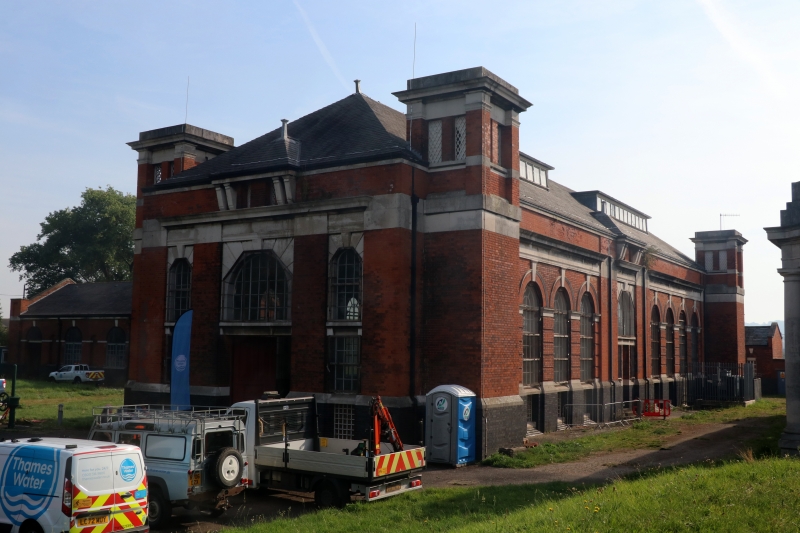
SWAN AND PIKE LANE TQ 39 NE (east side) 21/287 Pump House at King George Pumping Station II GV Pump House. Opened 1913. Designed by William Booth Bryan for Metropolitan Water Board. English bond red brick with limestone dressings, set on blue brick plinth; hipped Welsh slate roof Edwardian Baroque style. 9 x 3 bay elevations. Corner turrets with moulded stone cornices and diamond latticed windows; stone cill band beneath turret windows continued as moulded stone string course beneath parapets of main elevations. 9-bay side elevations have tall windows with glazing bars set in semi-circular arched architraves, with moulded stone edge to each arch set on moulded imposts, divided by rusticated brick pilasters; cast-iron casements with glazing bars set in plinth beneath; wide raised pilasters flank narrow entrance bay, which has bracketed hipped gablet and diamond-latticed lights set above tall semi-circular architrave with glazing bars to window set in rusticated stone surround above panelled door. Glazed clerestorey lights to roof. 3-bay end eleva- tions have similar entrance bay with panelled double doors, flanked by narrow revealed bays with glazing-bar windows, set in rusticated stone semi-circular arched architrave above and square-headed architrave below. Interior: glazed white brick walls, with dado and cornice of green brick; large cast-iron gantry moves along top of cornices; cast-iron roof trusses. Gas bags, housed in 5 circular cast-iron casings, supplied gas to 5 'Humphrey' gas pumps, housed in deep brick-lined pits, of which two remain 'in situ'. Each cast-iron pump, built by Siemens Brothers Limited, acted through internal combustion to raise 40 million gallons of water from the Lea Navigation into the King George Reservoir each day. Each pit has 4 water admission valves, arranged in a ring casing around base of combustion chamber, the water then being compressed into a cast-iron play pipe via the Water Tower House (q.v.) and Inlet Pipes and Weir (q.v.) into the reservoir. The pumps, the invention of H A Humphrey, dispensed with the usual pistons, flywheels etc, and were provided with their momentum by the free movement or oscillation of water between pump and tower: they are the first example of their type in the world. (The Engineer, March 14, 1913, pp.269-275).
Listing NGR: TQ3728697892
External links are from the relevant listing authority and, where applicable, Wikidata. Wikidata IDs may be related buildings as well as this specific building. If you want to add or update a link, you will need to do so by editing the Wikidata entry.


Other nearby listed buildings