Latitude: 53.4891 / 53°29'20"N
Longitude: -2.1034 / 2°6'12"W
OS Eastings: 393234
OS Northings: 399161
OS Grid: SJ932991
Mapcode National: GBR FXR2.DZ
Mapcode Global: WHB9J.NKKJ
Plus Code: 9C5VFVQW+JJ
Entry Name: Holy Trinity Church
Listing Date: 19 April 1993
Grade: II
Source: Historic England
Source ID: 1084305
English Heritage Legacy ID: 358721
Also known as: Holy Trinity Church, Ashton-under-Lyne
ID on this website: 101084305
Location: Holy Trinity Church, Crowhill, Tameside, Greater Manchester, OL6
County: Tameside
Electoral Ward/Division: St Peter's
Parish: Non Civil Parish
Built-Up Area: Ashton-under-Lyne
Traditional County: Lancashire
Lieutenancy Area (Ceremonial County): Greater Manchester
Church of England Parish: Ashton-under-Lyne The Good Shepherd
Church of England Diocese: Manchester
Tagged with: Church building
The following buildings shall be added to the list:-
ASHTON-UNDER-LYNE DEAN STREET SJ 99 NW
1478-4/10003 HOLY TRINITY CHURCH
- II
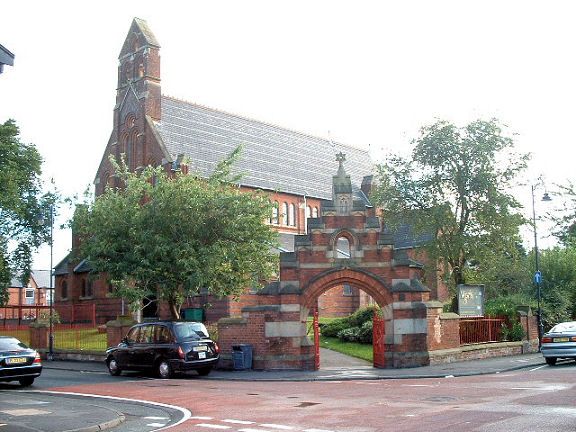
Anglican church. 1876-8. By Henry and Medland Taylor, for George Heginbottom, patron with late C20 alterations by G. Holland, to provide community facilities within the church. Red brick with blue brick banding and patterning, and ashlar sandstone dressings. Coped gables, and patterned Welsh slate roof coverings. Buttressed belfry to west end, above lean-to baptistry and flanking porch. Tall nave roof extends over chancel and apsidal sanctuary, with single storey chevet beyond south aisle with organ chamber to east end, north aisle with vestry porch also to east end. West gable with lean-to roof over baptistry and porches, pierced by stepped piers of twin flying buttresses, supporting pilaster buttresses to gabled belfry, with three bell-openings in stepped pointed arches. Diaper work patterning to nave gable with tall twin lancets below stepped roundel with quatre foil light to centre and single outer lancets beyond buttresses. 3 bay lean-to, with 3 lights to baptistry and 2 lights to flanking porches. Porch doorways beneath moulded brick stepped arches with simple hood moulds above. Double planked doors with decorative scrollwork, hinge straps. Five-bay chancel and four bay aisles, the west end bay a stair bay to each side. 2 pairs of coupled clerestorey lancets to each bay, 1:2:2:2:1 lancets to each aisle, including stair bay. Low buttresses define aisle bays, pilasters the clerestorey bays. Twin lancets to projecting south gable organ chamber, and south vestry door with stepped segmental arch rising from shouldered springers. Decorative ironwork hinge-straps with trinitarian motif; a double triangle strap ends. Such motifs are repeated in various forms throughout the building. 4 light windows to chevet, and cusped 2-light windows, windows with cinquefoil heads to lights below quatrefoils to septagonal sanctuary clerestorey. North side wall with gabled vestry chamber and lean-to vestry porch to east. Faceted link between north aisle and vestry expressed externally as corner tower vestry roof pierced by pier of flying buttresses supporting tall moulded brick chimney stack, with heavy corbelled cap. INTERIOR: Arcade piers of grey granite carry stepped pointed arches of moulded brick. Nave and clerestorey walling patterned in red and yellow brick compound chancel arch piers of red granite, with limestone capitals with foliage decoration. Sanctuary arcade carried on red granite columns against screen of repositioned choir stalls. Altar rail and plinth wall removed during re-ordering. Benches and decorative screen to vestry, and pierced timber screen with quatrefoil openings to separate organ chamber from entry to chevet. Stained glass windows to side walls depict St. Augustine and St. Chad on south side, St. George and St. Alban on north side. Complex roof trusses, arch-braced king post trusses with curved (close pace) struts alternating with arched scissor-braced trusses. The west end is now screened off and floored to form community facilities within the church, and encloses a 3-bay screen of columns formerly separating nave from baptistry. The church designed to seat between 700 and 800 people was erected at a cost of £10,000 on land given by the 7th Earl of Stamford and Warrington.
Listing NGR: SJ9323499161
External links are from the relevant listing authority and, where applicable, Wikidata. Wikidata IDs may be related buildings as well as this specific building. If you want to add or update a link, you will need to do so by editing the Wikidata entry.


Other nearby listed buildings