Latitude: 50.6681 / 50°40'5"N
Longitude: -3.3205 / 3°19'13"W
OS Eastings: 306778
OS Northings: 86218
OS Grid: SY067862
Mapcode National: GBR P6.MNVF
Mapcode Global: FRA 37Y9.L7H
Plus Code: 9C2RMM9H+7R
Entry Name: The Hermitage Including Pond, Rockeries and Waterfalls to the South
Listing Date: 10 February 1987
Grade: II*
Source: Historic England
Source ID: 1097547
English Heritage Legacy ID: 86208
ID on this website: 101097547
Location: Bicton Park, East Devon, EX9
County: Devon
District: East Devon
Civil Parish: Bicton
Traditional County: Devon
Lieutenancy Area (Ceremonial County): Devon
Church of England Parish: East Budleigh All Saints
Church of England Diocese: Exeter
Tagged with: Architectural structure
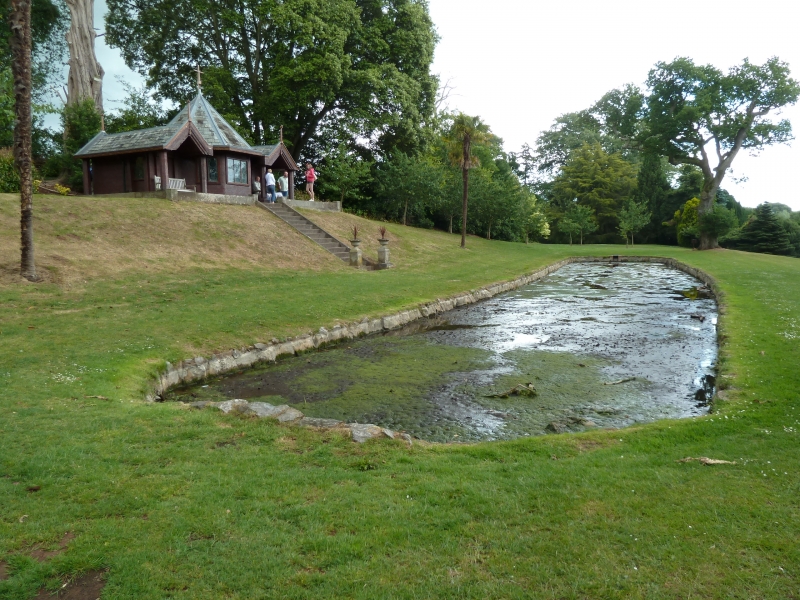
BICTON BICTON PARK SY 08 NE 3/7 The Hermitage including pond, - rockeries and waterfalls to the south - II* Summerhouse with pond and waterfalls close by. Probably circa 1840. Brick walls and stack, all clad with tiny fishscale shingles and rustic reeded frieze and plinth made of narrow vertical strips of wood with rounded faces; roof of shaped oak shingles and oak chimney shaft. Small but exceptionally picturesque summerhouse facing south comprising an octagonal room with end stack and pyramidal roof flanked by narrow gable-ended wings which are entrance lobbies. Single storey. Romantic and rustic in style. Symmetrical front. The main room has canted sides and contains fixed pane windows, a front 3-light window flanked by 2-light windows. All have flat architraves made by short round rods and they contain irregular patterns of stained glass, apparently made up from fragments of older windows. A frieze made up of strips of wood includes crudely made motifs such as rifles, crossed swords and flags. The soffit of the deep eaves is similarly finished. The pyramidal roof with its small cap have oak ridges enriched with small quatrefoils and the shingles have shaped edges with small bosses on top. The apex is surmounted by a rustic cross. The wings each side have porches front and back projecting as far as the main room. The open gables have fish scale shingled bargeboards surmounted by rustic finials and are supported on similarly clad octagonal posts with abaci and bases. The doorways have simple architraves and the soffit of the porch roof and space over the doorways has patterns made up of strips of wood and features motifs such as a crown and griffin. The rear elevation is similar to the front except here the stack projects square from the main room (also clad) and has a narrow oak chimney shaft rustically carved. Good interior, remarkably intact and complete with original furniture. All the interior walls and the roof are lined with dark brown basket-weave wicker-work. In the main room the floor is made up of tiny bones, apparently deer. The small fireplace has a granite surround containing panels of crude vermiculated rustication. Above it is the Rolle arms which, like the apex boss, is made from strips of wood. The rustic furniture comprises an octagonal table, its top also patterned with strips of wood and chairs of various sizes made up of turned timbers. Also a couple of probably African ethnographic trophies. The Hermitage stands on a terrace from which a flight of stone steps descend to a long stone-lined pond on a lower terrace and below them are 2 small rockeries with waterfalls. In the left (western) one a natural stream has been divided into several channels as it passes through a rockery planted with dwarf Welsh conifers and at the right end the middle channels join to form a small waterfall into a semi- circular pond whilst the outer channels flow round the outside to a drain. The right (eastern) rookery includes 3 waterfalls. The Hermitage is a lovely example of a romantic and rustic summerhouse set in the finest landscaped gardens in Devon, which also includes the Rolle family house, Bicton House (q.v.) and a number of fine listed buildings such as the Orangery (q.v.), Palm House (q.v.) and the furniture of the Italianate Gardens (q.v.).
Listing NGR: SY0677886218
External links are from the relevant listing authority and, where applicable, Wikidata. Wikidata IDs may be related buildings as well as this specific building. If you want to add or update a link, you will need to do so by editing the Wikidata entry.


Other nearby listed buildings