Latitude: 51.1041 / 51°6'14"N
Longitude: -2.329 / 2°19'44"W
OS Eastings: 377059
OS Northings: 133916
OS Grid: ST770339
Mapcode National: GBR 0TV.L0Q
Mapcode Global: VH97Z.LH3Z
Plus Code: 9C3V4M3C+J9
Entry Name: The Pantheon
Listing Date: 6 January 1966
Grade: I
Source: Historic England
Source ID: 1131102
English Heritage Legacy ID: 321259
Also known as: Stourhead Pantheon
ID on this website: 101131102
Location: Bonham, Wiltshire, BA12
County: Wiltshire
Civil Parish: Stourton with Gasper
Traditional County: Somerset
Lieutenancy Area (Ceremonial County): Wiltshire
Church of England Parish: Upper Stour
Church of England Diocese: Salisbury
Tagged with: Architectural structure
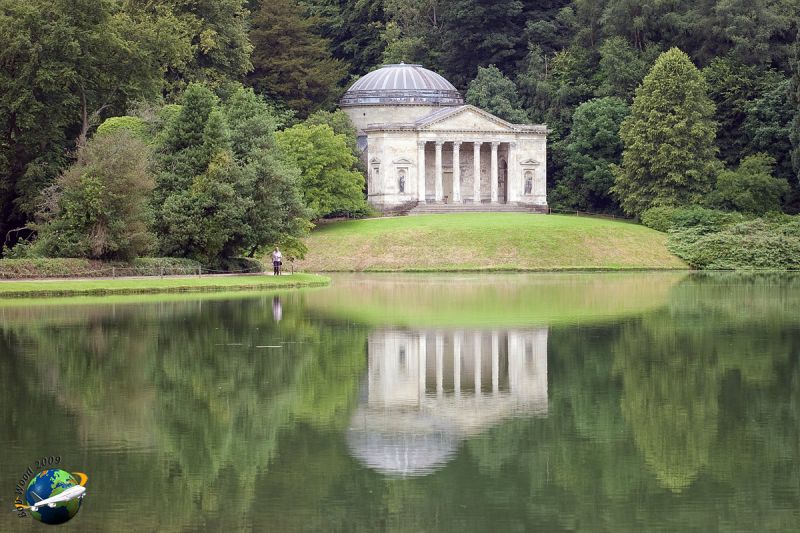
STOURTON WITH GASPER STOURHEAD GARDENS ST 73 SE (west side) 6/153 The Pantheon 6.1.66 GV I Temple. 1753-54 by Henry Flitcroft for Henry Hoare. Limestone ashlar. Tetrastyle in antis Corinthian portico, six step stylobate, flanking semi-circular niches in eared architraves with pediments, containing lead statues of Bacchus and Venus Callipygos, probably by John Cheere, modillioned entablature and pediment. Right returns have empty pedimented niches. Rear of portico narrows to vestibule with blind external walls, octagonal temple to rear with blind walls, drum to lead dome, rear wall retains roofline and corbelled stack of former room containing a stove from which warm air passed into the temple through a grille. Portico interior has double doors with six fielded panels in moulded architrave with pediment leading to vestibule. Vestibule has semi-circular niches with urns on pedestals, groin vaulted ceiling, 2 steps up to wrought iron gates by Benjamin Smith of Westminster in semi-circular arched opening leading to temple. Circular temple interior has coffered ceiling with frieze of bucrania and garlands, modillioned cornice, dome top-lit by stained glass circular window. Walls lined with seven egg and dart moulded niches, the one opposite the entrance contains Rysbrack's famous statue of Hercules, 1747, to the left is Rysbrack's Flora, lead statue of Diana and St Susanna. To the right of Hercules is an antique marble statue of Livia Augusta as Ceres, Meleager by John Cheere and Isis, the latter two are plaster. Above the niches and door are eight plaster relief panels of classical scenes by Benjamin Carter. The Pantheon was originally called the Temple of Hercules; it was built for Rysbrack's statue. It is probably the most important element in the Gardens, providing a focus for vistas across the lake from different points. (K. Woodbridge, The Stourhead Landscape, 1982; R. Gunnis, A Dictionary of British Sculptors, 1951)
Listing NGR: ST7705933918
External links are from the relevant listing authority and, where applicable, Wikidata. Wikidata IDs may be related buildings as well as this specific building. If you want to add or update a link, you will need to do so by editing the Wikidata entry.


Other nearby listed buildings