Latitude: 52.1298 / 52°7'47"N
Longitude: -1.4636 / 1°27'48"W
OS Eastings: 436816
OS Northings: 248080
OS Grid: SP368480
Mapcode National: GBR 6QK.GSF
Mapcode Global: VHBYB.LQ4N
Plus Code: 9C4W4GHP+WH
Entry Name: Church of St Peter
Listing Date: 30 May 1967
Last Amended: 8 April 1987
Grade: II
Source: Historic England
Source ID: 1184627
English Heritage Legacy ID: 306201
Also known as: St Peter's Church, Radway
ID on this website: 101184627
Location: St Peter's Church, Radway, Stratford-on-Avon, Warwickshire, CV35
County: Warwickshire
District: Stratford-on-Avon
Civil Parish: Radway
Built-Up Area: Radway
Traditional County: Warwickshire
Lieutenancy Area (Ceremonial County): Warwickshire
Church of England Parish: Radway St Peter
Church of England Diocese: Coventry
Tagged with: Church building
RADWAY TYSOE ROAD SP3648 (North side) 8/90 Church of St. Peter 30/05/67 (Formerly listed as in the C.P. of Priors Marston)
GV II
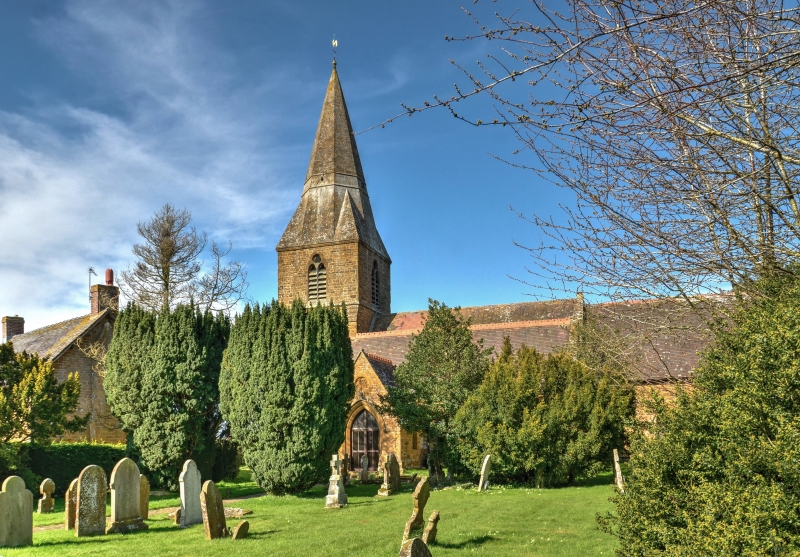
Church. 1866 by C. Buckeridge. Regular coursed Hornton ironstone. Tile roofs with cresting to chancel, aisles and organ chamber, and coped gable parapets. Aisled nave, chancel, west tower, north organ chamber and south porch. Gothic Revival style. 3-bay chancel, nave and aisles. Splayed plinth, angle buttresses with 2 offsets and moulded string course with fillet at sill height throughout. Chancel has additional moulding to plinth. 3-light east window with Intersecting tracery: each light has a trefoil in its top with a trefoiled lancet below, and elongated quatrefoil tracery. Hood mould with head stops. North and south sides have eastern window of paired trefoiled lancets. South side has central chamfered shouldered doorway with string course stepped up over it as hood mould. Eastern trefoiled lancet. Aisles are similar. South aisle has 2-light east window with tracery similar to chancel. South door in place of western window. Chamfered arch and hood mould with head stops. Double-leaf door. Porch has double splayed plinth. Doorway of 2 chamfered orders and hood mould with head stops. Apex of gable has sexfoiled circular IHS panel. Sides have small windows of paired trefoiled round arched lights. Interior has stone benches. North and south sides have windows of 2 trefoiled lights in straight head with pierced spandrel and hood mould with return stops. West windows of 2 trefoiled lights and trefoil. North organ chamber/vestry has east window of a single trefoiled ogee light in straight head with hood mould. 2 north windows are smaller simpler versions of aisle windows, without hood moulds. Tower of 4 stages with string courses. West angle and north-east and south-east buttresses with 3 offsets to 3 stages. Double splayed plinth. Second stage has west window of 2 trefoiled lights and elongated quatrefoil. Third stage has 3 narrow rectangular lights to 3 faces. West front has 2 badly eroded gargoyles, possibly from previous church. Bell stage has 2-light openings to each face with plate tracery of trefoiled lights and trefoiled circle. Moulded cornice. Broach spire has small central gablets with trefoil openings and string courses. Interior: chancel has piscina and recessed seat below. Arched door to vestry. String course, stepped down below seat and up over doors. Arch to organ chamber of 2 chamfered orders and hood mould, the inner dying into the wall. Wagon roof. Early English style chancel arch of 2 orders, the outer chamfered on shafts of contrasting grey stone, the inner with roll mouldings to chancel and nave on half-shaft. Hood moulds, with head stops to nave. Stiff leaf capitals and moulded bases. Nave has 3-bay Early English style arcades of 2 chamfered orders. Compound shafts with moulded capitals of grey stone and moulded bases. Continuous hood moulds springing from stiff leaf corbels. To east arches die into walls without responds; to west responds have inner order on half shaft, outer order carried straight down to square base. Scissor brace rafter roof with collars and ashlar pieces. Tower arch of 3 chamfered orders, outer continuous. Inner orders have composite half-shafts and moulded bases and capitals with nailhead ornament. North aisle has opening to organ chamber: left half of an arch of 2 chamfered orders, the outer stilted, the inner dying into the wall. Aisles have common rafter roofs with collars and ashlar pieces. Fittings: reredos of white marble with granite colonnettes. 3 cinqfailed arches; stiff leaf capitals. Encaustic tile chancel floor. Octagonal oak pulpit with panels of 2 blind trefoiled ogee arches and carved spandrels and frieze; round stone base turning octagonal. Original pews and lectern. Stone font with lobed bowl and composite stem. Stained glass: south aisle east window has 4 panels of C16/C17 Flemish glass; chancel south west has small fragment of glass; said to have come from Edgehill Tower (q.v.). Chancel east and south-east windows have C19 glass. Monuments: several from previous church. Chancel has north tomb recess with stilted arch and mid C15 (Pevsner) effigy of a priest. Tower south wall: Henry Kingsmill, died at Battle of Edgehill 1642. Damaged effigy in arched recess, and fine incised slab dated 1670. Elaborate coat of arms and fine lettering. Charles Hughes 1734. Large cartouche. Above recess Charles Chambers died 1854. Finely carved wall monument with predella showing a naval expedition. Long detailed inscription. Tower north wall. Sanderson Miller 1780; plain tablet. Sanderson Miller senior: mid C18 wall monument. F.S. Miller 1817. Tablet. (Buildings of England: Warwickshire, p.379).
Listing NGR: SP3681648080
External links are from the relevant listing authority and, where applicable, Wikidata. Wikidata IDs may be related buildings as well as this specific building. If you want to add or update a link, you will need to do so by editing the Wikidata entry.


Other nearby listed buildings