Latitude: 50.7949 / 50°47'41"N
Longitude: -1.1196 / 1°7'10"W
OS Eastings: 462146
OS Northings: 99851
OS Grid: SZ621998
Mapcode National: GBR VLH.NN
Mapcode Global: FRA 86JZ.ZL6
Plus Code: 9C2WQVVJ+X5
Entry Name: 91-93, High Street
Listing Date: 10 February 1989
Grade: II
Source: Historic England
Source ID: 1234617
English Heritage Legacy ID: 410592
ID on this website: 101234617
Location: Gosport, Hampshire, PO12
County: Hampshire
District: Gosport
Electoral Ward/Division: Town
Parish: Non Civil Parish
Built-Up Area: Gosport
Traditional County: Hampshire
Lieutenancy Area (Ceremonial County): Hampshire
Church of England Parish: Gosport Holy Trinity
Church of England Diocese: Portsmouth
Tagged with: Building
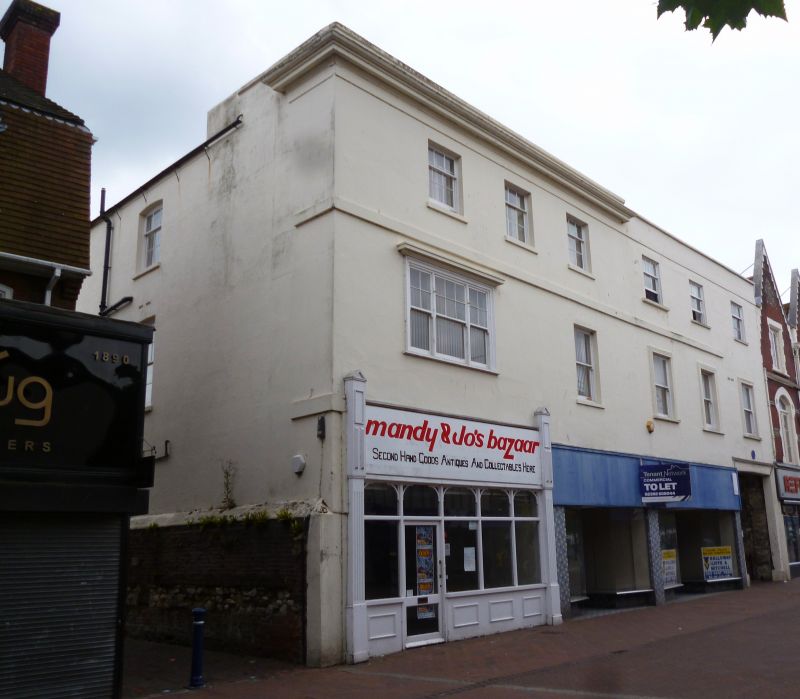
Former inn (The India Arms), now shops. Built in the early C18 and refronted in the early C19 with further alterations in the C20.
This list entry was subject to a minbor Enhancement on 29 February 2024 to amend the description and to add historic background
This list entry was subject to a Minor Amendment on 06/01/2020
SZ 6299 NE
8/10
GOSPORT HIGH STREET Nos 91-93 (consecutive)
[Formerly listed as Nos 91-94 (consec)]
II
Former inn (The India Arms), now shops. Built in the early C18 and refronted in the early C19 with further alterations in the C20.
MATERIALS: brick, rendered to front, plain tile roofs.
PLAN: two double depth houses, one of which was an inn from before 1750 (No 93); the other (Nos 91 & 92) may have been part of it from early on but does appear to be a different build. Both were definitely the same inn property by c1820 (engraving in Portsmouth Museum), subdivided again in the C20.
EXTERIORS: the street elevation has modern shops to the ground floor with a carriage opening to the right. Upper floors show two different buildings, six windows in all, second floor band over all but right-hand bay. First floor has C20 triple sash to left (No 91), four plain sashes to the right hand, three with stucco surrounds. Upper floor has six nine-paned sashes which appear in the c1820 engraving. Large projecting cornice to Nos 91 & 92. Parapets, roofs not visible. The rear elevations are of red brick with hipped tile roofs.
INTERIORS: surviving early C18 features include a panelled room, a moulded ceiling in what was possibly the dining room, with detail cornice (No 91), a corner cupboard, a staircase which is probably late C18, a tiled and lead lined ice-box (a remarkable survival from its days as an inn) and a number of door architraves.
Listing NGR: SZ6213899852
Gosport is recorded in 1206 as a ‘newly built’ port town. That which survives of the medieval grid pattern of streets and tenements is situated in what is now ‘Old Gosport’ and incorporates the east-west running High Street (‘Middle Street’ on C18 maps) which is flanked by North Street and South Street, with small cross streets and lanes (such as North Cross Street, South Cross Street and Bemister’s Lane) linking the three. By 1417, Gosport was involved in the defensive system of Portsmouth Harbour with a blockhouse (fort) on Blockhouse Point. A ferry service linked the two towns from the C16 onwards and the subsequent development of Gosport was largely driven by its role in defending the western landward and seaward approaches to the harbour and supplying the Royal Navy. From the late C17 onwards, a line of ramparts and artillery bastions, known as the Gosport Lines, were built surrounding the town. Gosport’s growth over the following three centuries mirrored that of the navy, as boatyards, rope-making facilities, victualling yards, a prison, hospitals, barracks and naval bases were constructed. It also led to demand for housing in large new residential areas beyond the Gosport Lines. During the Second World War, the town suffered major bomb damage and there was extensive post-war rebuilding after 1945.
The India Arms was built in around the early C18 and was formerly one of the premier coaching inns of Gosport. It would have had strong associations with C18 and C19 naval personnel. The first meeting of the Gosport Council took place there on 19 May 1763. The India Arms was refronted in around the early C19. There were further alterations in the C20 and the ground floor is now (2024) utilised as shops.
External links are from the relevant listing authority and, where applicable, Wikidata. Wikidata IDs may be related buildings as well as this specific building. If you want to add or update a link, you will need to do so by editing the Wikidata entry.


Other nearby listed buildings