Latitude: 51.529 / 51°31'44"N
Longitude: -0.1111 / 0°6'39"W
OS Eastings: 531127
OS Northings: 182809
OS Grid: TQ311828
Mapcode National: GBR M6.62
Mapcode Global: VHGQT.1T4R
Plus Code: 9C3XGVHQ+HH
Entry Name: Young Womens Christian Association Alexander House and Attached Railings
Listing Date: 30 September 1994
Grade: II
Source: Historic England
Source ID: 1279523
English Heritage Legacy ID: 369115
ID on this website: 101279523
Location: Finsbury, Islington, London, WC1X
County: London
District: Islington
Electoral Ward/Division: Clerkenwell
Parish: Non Civil Parish
Built-Up Area: Islington
Traditional County: Middlesex
Lieutenancy Area (Ceremonial County): Greater London
Church of England Parish: Clerkenwell St Mark
Church of England Diocese: London
Tagged with: Architectural structure
ISLINGTON
TQ3182NW LLOYD BAKER STREET 635-1/68/986 YWCA Alexandra House and attached railings
GV II
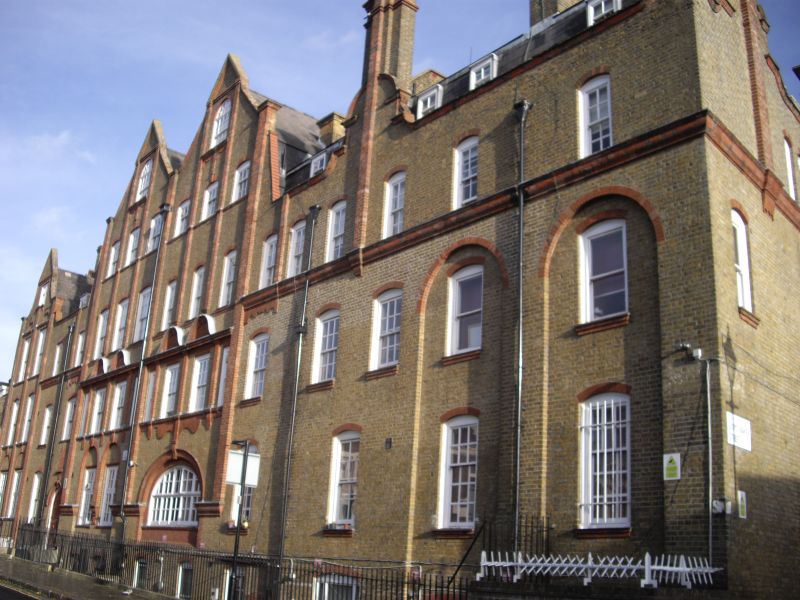
Former House of Retreat of the Sisters of Bethany (convent and school). 1882-4, Ernest Newton, with some later alterations. Yellow brick in Flemish bond with dressings of red brick and gauged red rubbd brick. Four and five storeys over half-basement. Irregular and picturesque elevations in the 'Queen Anne' style with gables, high chimneys with moulded tops, swept parapets, stringcourses, pilasters, blank arches and segmentally headed windows with wide sash boxes in the 'Queen Anne' style. Slated roofs, some within a curbed mansard. Iron area railings towards Lloyd Square. The Lloyd Baker Street elevation (1882) has three main storeys in the centre, with steps up to a round-arched entrance containing double doors partly panelled and partly now glazed, all within an outer arch with hood mould and keystones. Above, two giant stacks rise from corbels at first-floor level, break through the cornice and are linked by an open arch. Higher flanks, rising to two small segment-headed gables on the right (altered from original form) and swept parapets and a further high chimney on the left. At the far right end of the front, a small addition of c.1905 with two main storeys in a Tudor style, of red brick with stone dressings, leaded windows and a straight gable with stone finial. The longer Lloyd Square front (east portion 1882, west portion 1884), is of three main storeys above ground, with shaped gables and one chimney breaking through the line of the swept parapet. Tops of gables slightly altered after war damage. A moulded stringcourse runs along the eastern portion of the front above first-floor level; in the western portion, which has a simple arched entrance, the first-floor windows have projecting segmental heads. One ground-storey window is within a broad segmental arch with hood mould and keystone. The interior retains a single-storey, flat-roofed cloister with a corridor along its north and west sides, with panelled Gothic door to former chapel in north-west position. Along the corridor, buttressed brick piers alternate with segment-headed arches filled mainly with three light wooden windows. Original rear brick elevations largely intact. On the upper storeys north of the cloister, a neo-Georgian extension in brick of c.1935. See also Studio (Former Chapel), Lloyd Baker Street.
Listing NGR: TQ3112782809
External links are from the relevant listing authority and, where applicable, Wikidata. Wikidata IDs may be related buildings as well as this specific building. If you want to add or update a link, you will need to do so by editing the Wikidata entry.


Other nearby listed buildings