Latitude: 51.4514 / 51°27'4"N
Longitude: -2.6245 / 2°37'28"W
OS Eastings: 356703
OS Northings: 172673
OS Grid: ST567726
Mapcode National: GBR C1L.HK
Mapcode Global: VH88M.GSD7
Plus Code: 9C3VF92G+H6
Entry Name: Numbers 1 to 10 (Consecutive) and Attached Front Basement Area Railings
Listing Date: 8 January 1959
Last Amended: 30 December 1994
Grade: II
Source: Historic England
Source ID: 1282030
English Heritage Legacy ID: 380905
ID on this website: 101282030
Location: Hotwells, Bristol, BS8
County: City of Bristol
Electoral Ward/Division: Clifton
Parish: Non Civil Parish
Built-Up Area: Bristol
Traditional County: Gloucestershire
Lieutenancy Area (Ceremonial County): Bristol
Church of England Parish: Clifton Holy Trinity with St Andrew the Less and St Peter
Church of England Diocese: Bristol
Tagged with: Building
BRISTOL
ST5672NE WINDSOR TERRACE, Clifton 901-1/13/1139 (North side) 08/01/59 Nos.1-10 (Consecutive) and attached front basement area railings (Formerly Listed as: WINDSOR TERRACE Nos.1-10 (Consecutive))
GV II
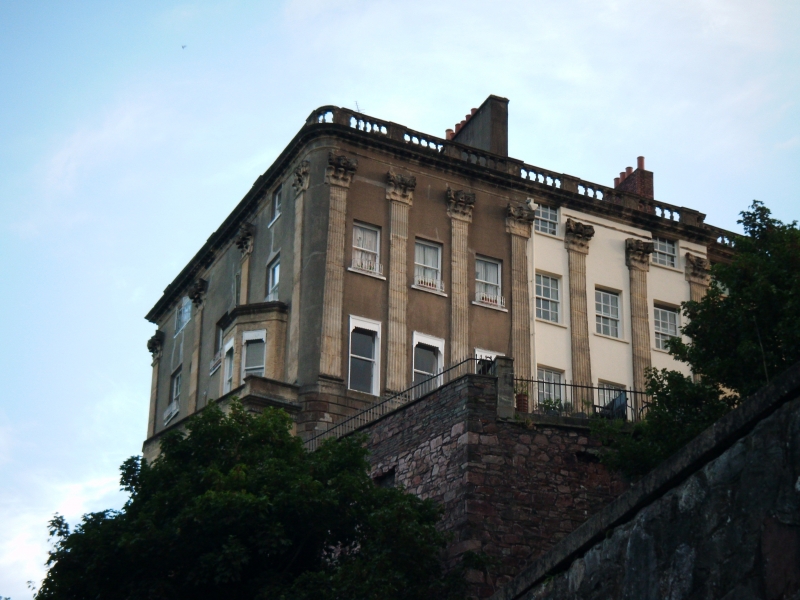
Terrace of 10 houses. Retaining walls begun 1782 by William Watts, centre pair of design, probably by John Eveleigh, c1790, completed to a much reduced design by John Drew 1807. Limestone ashlar and render, party wall stacks and slate mansard roofs. Double-depth plan. Late Georgian style. Each of 2 storeys, attic and basement; 3-window range. A massive raised retaining wall and terrace below a composed palace front with a slight concave curve, has the end and middle pairs broken forward, the latter slightly raised; ashlar rusticated ground floor, rendered apart from Nos 5 & 6, to a band, fluted Corinthian pilasters to the upper floors, a full entablature to Nos 5 & 6 only, the rest have a thin string and modillion cornice, with dies and balustrade, ramped up to the centre section. Semicircular-arched ground-floor openings with incised voussoirs; lower right-hand doorways have 5-pane fanlights, No.1 has a teardrop fanlight with a lantern, reeded transom and 6-panel doors with reeded flush lower panels. 6/6-pane sashes, 9/9-pane first-floor sashes, with 6/6/6-pane triple sashes to No.5, and wrought-iron basket balconies with cast-lead decoration to Nos 2, 4, 5, 6 and 8; third-floor windows below the cornice to Nos 2-4, attic storeys added to Nos 7 & 8. The left return has rounded corners and a single-storey porch with semicircular arches, 3 to the side, with imposts, and a canted first-floor bay. Steps down to basement areas and doorways. INTERIOR: centre pair: entrance hall divided by a semicircular arch from a central toplit lateral open-well stair with stick balusters, ramped rail and curtail; marble fireplaces have moulded jambs and corner roundels, first-floor front rooms have marble fire surrounds with moulded jambs with wreaths and bouquets; arched recesses to ground and first floors; elaborate cornices, 6-panel doors and panelled shutters. No.6 has round glazed lights set in the ground-floor stair treads. SUBSIDIARY FEATURES: attached spear-headed wrought-iron basement area railings and gates. HISTORICAL NOTE: most of Watts' capital was spent on the massive revetment (qv) on which the terrace was built. Begun by Eveleigh as a larger crescent, but only the middle pair was built before the financial collapse of 1791. John Drew completed the project to a confused version of the original. Hannah More the noted educationalist died at No.4 in 1833. Painted by Samuel Jackson in c1825 & 1839. Part of the visually very important view of Clifton from across the Avon. (Gomme A, Jenner M and Little B: Bristol, An Architectural History: Bristol: 1979-: 219; Ison W: The Georgian Buildings of Bristol: Bath: 1952-: 226; Greenacre F and Stoddard S: The Bristol Landscape, The Watercolours of Samuel Jackson: Bristol: 1986-: 41, 55).
Listing NGR: ST5667572662
External links are from the relevant listing authority and, where applicable, Wikidata. Wikidata IDs may be related buildings as well as this specific building. If you want to add or update a link, you will need to do so by editing the Wikidata entry.


Other nearby listed buildings