Latitude: 53.8187 / 53°49'7"N
Longitude: -1.5512 / 1°33'4"W
OS Eastings: 429645
OS Northings: 435921
OS Grid: SE296359
Mapcode National: GBR BHB.CW
Mapcode Global: WHC9D.48LT
Plus Code: 9C5WRC9X+FG
Entry Name: Sugarwell Court
Listing Date: 5 February 1987
Last Amended: 11 September 1996
Grade: II
Source: Historic England
Source ID: 1375170
English Heritage Legacy ID: 466052
Also known as: Cliff Tannery
ID on this website: 101375170
Location: Buslingthorpe, Leeds, West Yorkshire, LS7
County: Leeds
Electoral Ward/Division: Chapel Allerton
Parish: Non Civil Parish
Built-Up Area: Leeds
Traditional County: Yorkshire
Lieutenancy Area (Ceremonial County): West Yorkshire
Church of England Parish: Woodhouse and Wrangthorn
Church of England Diocese: Leeds
Tagged with: Tannery Hall of residence
LEEDS
SE2935 MEANWOOD ROAD 714-1/24/245 (North East side) 05/02/87 Sugarwell Court (Formerly Listed as: MEANWOOD ROAD (North East side) Sugarwell Works)
GV II
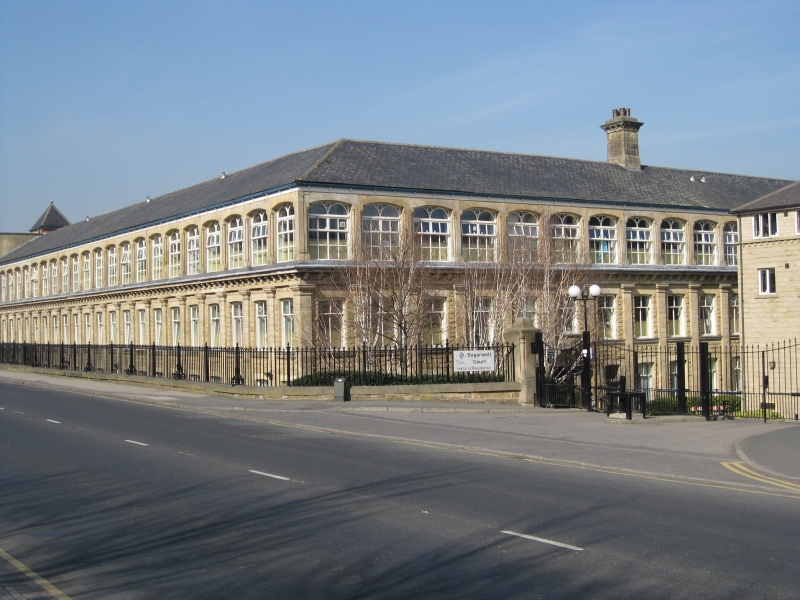
Formerly known as: Cliff Tannery MEANWOOD ROAD. Tannery, now student accommodation. Dated 1866, additions c1900, converted c1993. For Edward Kitchen. Rusticated sandstone with ashlar dressings, C20 slate roof. 2 ranges forming L-shape. 3 storeys, the top storey added, over a basement near Meanwood Beck; 24-bay entrance range, roadside range 23 bays. Plinth. Between bays, 2-storey pilasters with plain capitals rise from band to support band and modillion cornice, the windows on 2 lower floors having moulded sills and monolithic cambered-arched lintels, frames replaced. 3rd floor has wider 2-light windows, the top lights with round-arched glazing bars, separated by pilasters and with segmental-arched lintels. 3-bay entrance, in bays 5-7 of entrance range, has round-arched carriageway, moulded archivolt with keystone bearing date and scrolled shield with bird-head crest rising from piers flanked by colonnettes and with giant head capitals, possibly portraits of the owners. Window above this set slightly higher than other 1st-floor windows; to either side a pedestrian door with cambered-arched overlight in pulvinated surround. Eaves gutter brackets. Modillion cornice to ridge stack over entrance. INTERIOR: central rows of circular cast-iron columns supporting timber cross-beams, 1st-floor columns more slender than those below. At S end of roadside range a broad flight of stone stairs rising to upper floor. HISTORICAL NOTE: Edward Kitchen started tanning in 1854 in Harper Street; he moved to this site (then Cliff Tannery) after building 63 back-to-back houses for his workpeople (demolished). His tannery produced East India Kips, a Leeds speciality, and Cape and Sidney Butts. Skins were dried on the top floor and softened and soaked in water and lime in the rear glazed yard (demolished). Water was drawn from a roadside well and pumped from Meanwood Beck. Leeds was a major tanning centre in the C19, second only to
London by the 1850s, and this is one of the best-surviving mid C19 tanneries. (Powell, K et al: Save Britain's Heritage; Leeds - a lost opportunity?).
Listing NGR: SE2964535921
External links are from the relevant listing authority and, where applicable, Wikidata. Wikidata IDs may be related buildings as well as this specific building. If you want to add or update a link, you will need to do so by editing the Wikidata entry.


Other nearby listed buildings