Latitude: 53.3807 / 53°22'50"N
Longitude: -1.4697 / 1°28'10"W
OS Eastings: 435374
OS Northings: 387220
OS Grid: SK353872
Mapcode National: GBR 9HK.FX
Mapcode Global: WHDDP.D9D5
Plus Code: 9C5W9GJJ+74
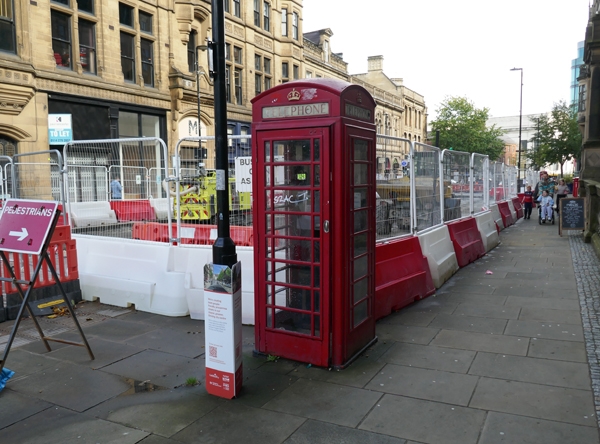
Entry Name: K6 telephone kiosk outside north-west corner of Sheffield Town Hall
Listing Date: 1 August 2024
Grade: II
Source: Historic England
Source ID: 1489020
ID on this website: 101489020
County: Sheffield
Electoral Ward/Division: City
Parish: Non Civil Parish
Built-Up Area: Sheffield
Traditional County: Yorkshire
Lieutenancy Area (Ceremonial County): South Yorkshire
K6 telephone kiosk, designed in 1935 by Sir Giles Gilbert Scott.
K6 telephone kiosk, designed in 1935 by Sir Giles Gilbert Scott.
The K6 is a standardised design made of cast iron (with a hardwood door), painted red overall with long horizontal glazing in the door and sides and with the crowns situated on the top panels being applied not perforated. There are rectangular white display signs, reading TELEPHONE beneath the shallow curved roof. It has modernised internal equipment.
This example stands in front of two listed buildings: Sheffield Town Hall (Grade I), and the Police box (Grade II) dating from 1928, approximately 10m to the west. The telephone kiosk has a strong visual and contextual relationship with these two listed buildings.
The K6 telephone kiosk is a milestone of C20 industrial design. The K6 was designed by Sir Giles Gilbert Scott in 1935 for the General Post Office, on the occasion of King George V's Silver Jubilee. The K6 was a development from his earlier highly successful K2 telephone kiosk design of 1924, of neoclassical inspiration. The K6 was more streamlined aesthetically, more compact and more cost-effective to mass produce. Sir Giles Gilbert Scott (1880-1960) was one of the most important of modern British architects; his many celebrated commissions include the Anglican cathedral of Liverpool and Battersea Power Station. The K2 and K6 telephone kiosks can be said to represent a very thoughtful adaptation of architectural tradition to contemporary technological requirements. Well over 70,000 K6s were eventually produced. In the 1960s many were replaced with far plainer kiosk types but remaining examples of the K6 continue to be an iconic feature on Britain's streetscapes. A telephone call box is first marked in this location on the Ordnance Survey 1:2,500 map published in 1935.
The K6 telephone kiosk outside the north-west corner of Sheffield town hall, designed in 1935 by Sir Giles Gilbert Scott, is listed at Grade II for the following principal reasons:
Architectural interest:
* as an iconic example of industrial design, showing Sir Giles Gilbert Scott’s adaptation of neoclassical forms for a modern technological function.
Historic interest:
* the K6 telephone kiosk was designed to celebrate the Silver Jubilee of King George V in 1935 by the eminent architect Sir Giles Gilbert Scott, further developing his successful K2 telephone kiosk design of 1924.
Group value:
* for its contribution to the streetscape and its strong visual and contextual relationship with the Grade I-listed Sheffield town hall and the Grade II-listed Police box adjacent to the town hall.


Other nearby listed buildings