Latitude: 50.61 / 50°36'35"N
Longitude: -1.9634 / 1°57'48"W
OS Eastings: 402684
OS Northings: 78920
OS Grid: SZ026789
Mapcode National: GBR 459.NFN
Mapcode Global: FRA 67SG.6X2
Plus Code: 9C2WJ25P+XJ
Entry Name: Railway overbridge
Listing Date: 18 September 2025
Grade: II
Source: Historic England
Source ID: 1493992
ID on this website: 101493992
County: Dorset
Civil Parish: Swanage
Built-Up Area: Swanage
Traditional County: Dorset
Lieutenancy Area (Ceremonial County): Dorset
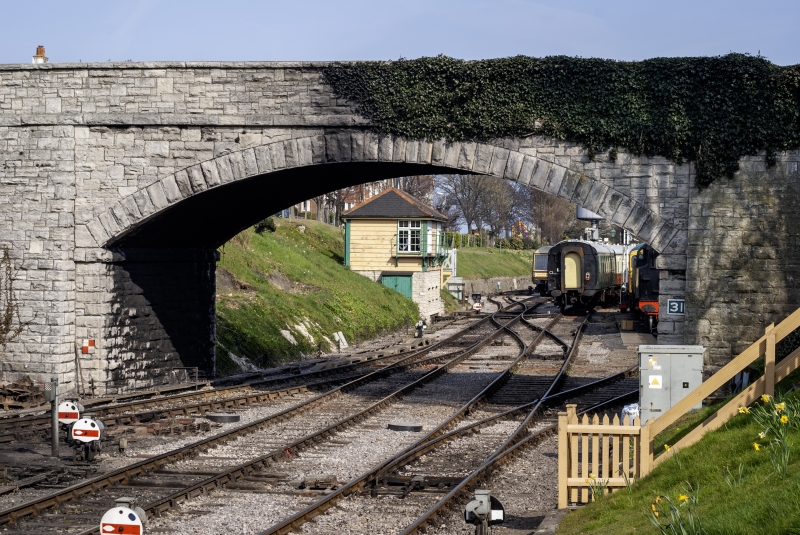
A bridge over the Swanage Railway which opened in 1885 and was designed by Galbraith and Church, the engineers for the line. It is neatly made, and has strong group value with the goods shed, locomotive house and turntable pit, strengthened by its shared architectural style with these contemporary structures.
Bridge over railway. Built in 1885 for the Swanage Railway, and designed probably by W R Galbraith.
DESCRIPTION
It is constructed from cut and squared, rock-faced Purbeck stone with little ornament. It has a single-span segmental arch with a single row of voussoirs, battered abutments and a string course. The parapet walls and end piers have rock-faced coping.
Following the opening of the London & South West Railway (LSWR) between Southampton and Dorchester via Wareham in 1847 several unsuccessful attempts were made to establish a branch line from Wareham (at Worgret Junction to the west of the town) to Swanage. An Act of Parliament in 1880 authorised the railway and responsibility for its construction was split between the Swanage Railway Company, who financed it, and the LSWR. William Galbraith, LSWR’s engineer for new works, and his partner and former pupil, R F Church worked on a number of branch lines independently, including Swanage, and were responsible for surveying its route and drawing up specifications and plans. The line opened in May 1885, carrying passengers and freight, including quarried stone, ball clay and coal. Stations were built at Corfe Castle (listed at Grade II) and at Swanage, designed by Galbraith and Church and constructed by Bull & Co of Southampton. A new station (listed at Grade II) was also built at Wareham in 1886-1887 on a different site to the mid-C19 one in order to connect with the new branch line. An overbridge was built to the west of Swanage Station to carry Northbrook Road over the double track railway.
The number of rail passengers travelling to Swanage increased significantly as the town’s popularity as a seaside resort grew, and in 1938 the station was enlarged. Freight traffic to Corfe Castle and Swanage ceased in 1965, although a residual service handling mineral traffic continued along part of the line. Passenger numbers fell in the second half of the C20 as vehicle use increased; through trains from London to Corfe Castle and Swanage stopped in 1969, and the last passenger service from Swanage to Wareham ran on 1 January 1972. The track was lifted soon after the railway closed, though some had been removed in the late 1960s, and the goods yard became a car park and bus terminus.
In 1975 some of the buildings at Swanage Station were leased to the Swanage Railway Society (Swanage Railway Company since 1979). They were repaired and, after relaying a short section of the track, part of the line reopened in 1979 as a privately-run preserved railway. In 1995 the track was relaid as far as Corfe Castle, and to the main line west of Wareham station in 2002.
The railway overbridge carrying Northbrook Road over the Swanage Railway which opened in 1885, is listed at Grade II for the following principal reasons:
Architectural interest:
* although not part of the earliest and pioneering phase of railway building, the bridge is well-executed in its construction and surface dressing, and is unaltered.
Group value:
* it benefits from strong group value with the adjacent and contemporary Grade II goods shed and the locomotive house and turntable pit, which is enhanced by its shared architectural style with these structures.
Historic interest:
* the construction of the railway contributed to the widespread use of Purbeck stone in Dorset and beyond, and to the development of Swanage as a seaside destination.


Other nearby listed buildings