Latitude: 51.4506 / 51°27'2"N
Longitude: -2.6208 / 2°37'14"W
OS Eastings: 356955
OS Northings: 172584
OS Grid: ST569725
Mapcode National: GBR C2L.9V
Mapcode Global: VH88M.JSBV
Plus Code: 9C3VF92H+6M
Entry Name: Chapel Row and Attached Front Area Walls, Piers and Railings
Listing Date: 8 January 1959
Last Amended: 30 December 1994
Grade: II
Source: Historic England
Source ID: 1202307
English Heritage Legacy ID: 379808
Also known as: 266 Chapel Row and attached front area walls, piers and railings
ID on this website: 101202307
Location: Hotwells, Bristol, BS8
County: City of Bristol
Electoral Ward/Division: Clifton
Parish: Non Civil Parish
Built-Up Area: Bristol
Traditional County: Gloucestershire
Lieutenancy Area (Ceremonial County): Bristol
Church of England Parish: Clifton Holy Trinity with St Andrew the Less and St Peter
Church of England Diocese: Bristol
BRISTOL
ST5672NE HOTWELL ROAD, Hotwells 901-1/13/1443 (South East side) 08/01/59 No.266 Chapel Row and attached front area walls, piers and railings (Formerly Listed as: HOTWELL ROAD (North side) No.266 Chapel Row)
GV II
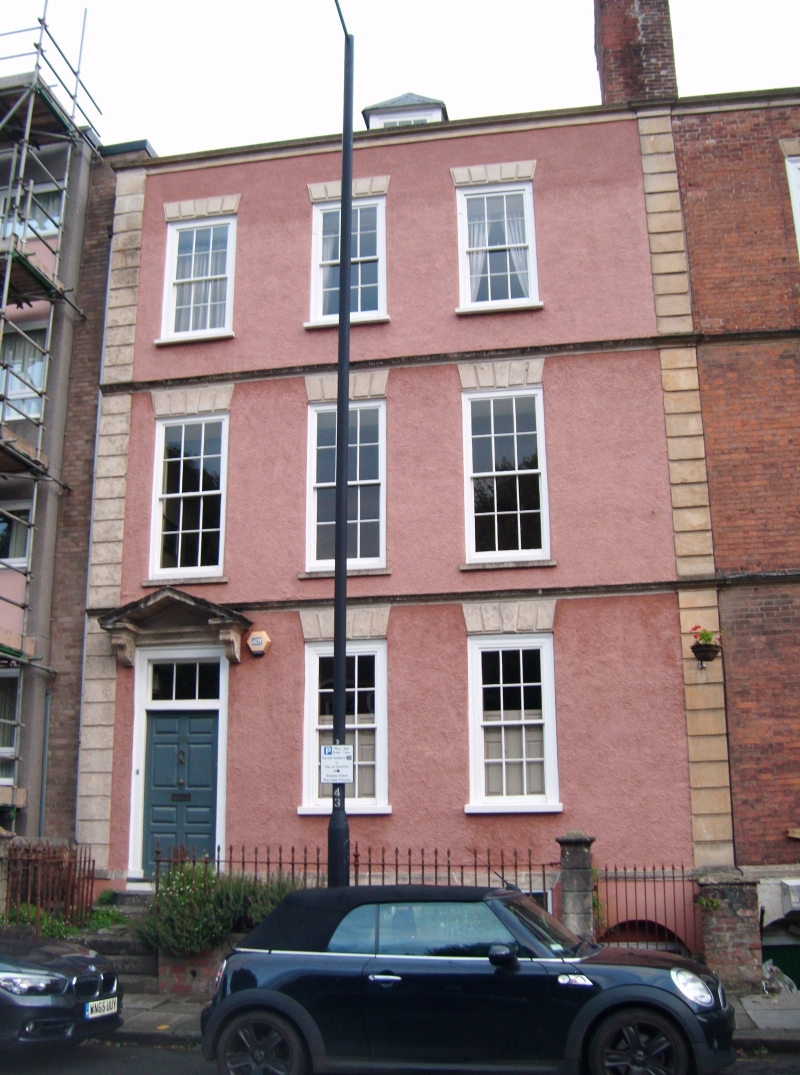
Attached house. 1725-27. By George Tully. Render over brick with limestone dressings, brick party wall stacks and a pantile double-depth roof half-hipped to the left. Double-depth plan. Early Georgian style. 3 storeys and basement; 3-window range. Articulated by rusticated pilaster strips to a moulded coping, with moulded strings to each floor running over the pilasters. Left-hand doorway has scrolled brackets to a pediment, a moulded frame, 3-pane overlight and 8-panel door. Lintels with rusticated voussoirs to 6/6-pane sashes in flush frames, taller on the first floor; single hipped dormer. Right-hand steps down to basement door set in semicircular arch. Rear elevation has a full-height hipped projection across the party wall with No.264, a central 8/8-pane stair sash, and a tall half dormer set back with a 6/6-pane sash. INTERIOR not inspected. SUBSIDIARY FEATURES: attached front area brick walls and capped, banded piers to spear-headed cast-iron railings and gates with urn finials. Part of the Dowry Square development laid out by Tully from 1720. (Gomme A, Jenner M and Little B: Bristol, An Architectural History: Bristol: 1979-: 103; Ison W: The Georgian Buildings of Bristol: Bath: 1952-: 157).
Listing NGR: ST5695572584
External links are from the relevant listing authority and, where applicable, Wikidata. Wikidata IDs may be related buildings as well as this specific building. If you want to add or update a link, you will need to do so by editing the Wikidata entry.


Other nearby listed buildings