Latitude: 53.7739 / 53°46'25"N
Longitude: -2.2224 / 2°13'20"W
OS Eastings: 385437
OS Northings: 430858
OS Grid: SD854308
Mapcode National: GBR DSXS.NX
Mapcode Global: WHB83.TDWR
Plus Code: 9C5VQQFH+G2
Entry Name: Towneley Hall
Listing Date: 10 November 1951
Last Amended: 19 November 1997
Grade: I
Source: Historic England
Source ID: 1247299
English Heritage Legacy ID: 467230
ID on this website: 101247299
Location: Towneley Park, Burnley, Lancashire, BB11
County: Lancashire
District: Burnley
Electoral Ward/Division: Rosehill with Burnley Wood
Parish: Non Civil Parish
Built-Up Area: Burnley
Traditional County: Lancashire
Lieutenancy Area (Ceremonial County): Lancashire
Church of England Parish: Burnley St Stephen
Church of England Diocese: Blackburn
Tagged with: House
BURNLEY
SD8530 TOWNELEY PARK 906-1/7/141 Towneley Hall 10/11/51 (Formerly Listed as: TODMORDEN ROAD Towneley Hall)
GV I
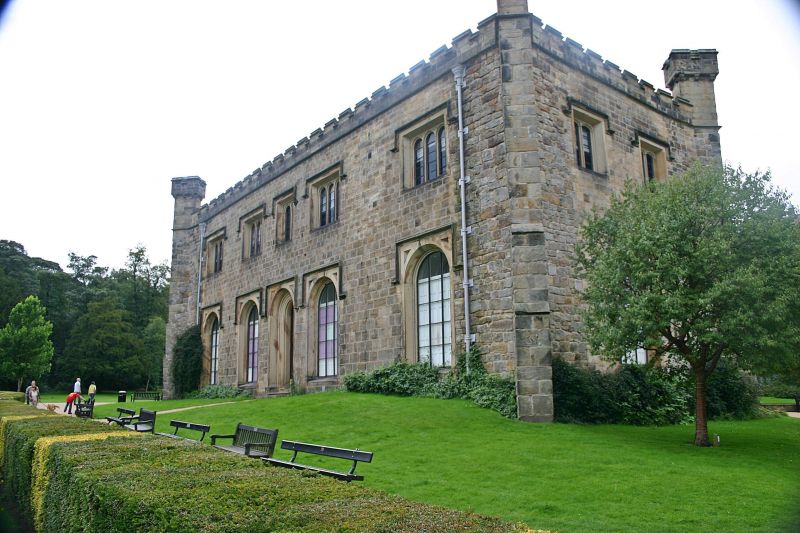
Country house, formerly the seat of the Towneley family, now museum and art gallery. Begun c1400, completed in quadrangular form c1500; north-west wing rebuilt c1626, and widened by additions to the outer side c1737; north-east gatehouse range demolished in early C18; south-west hall-range rebuilt c1725-6, and south-east wing remodelled in 1760s, and remodelled again 1812-19 by Jeffry Wyatt (subsequently Sir Jeffry Wyatville), who also added an external basement passage and a porch to the front of the hall, and the turrets and battlements; north-west tower added 1847. Mostly large sandstone rubble brought to courses, with freestone dressings, and hipped slate roofs concealed by embattled parapets. Now largely Gothick style. PLAN: U-plan formed by hall-range on north-west/south-east axis with long north-west and south-east wings. EXTERIOR: 2-storey great hall with 4-storey corner turrets, 3-storey north-west wing and 2-storey south-east wing all to the same height except the turrets; with basements. The hall-range and its turrets, 1:2:1 windows, symmetrical, with a projected basement serving as a plinth, has four 2-light mullioned windows to the basement, a tall square Gothick porch in the centre, protecting a heavy oak door inscribed "R et AHSOISTA / TW FEC A DNI MdXXX" (believed to have come from Standish Hall near Wigan) flanked by tall 18-pane windows with moulded surrounds, a clock face in the centre of the upper floor flanked by square 3-light casements with hoodmoulds, an embattled parapet, and 2 downspouts with rainwater heads which have raised lettering "R T/1726"; the projecting rectangular turrets both have mullioned 4-light windows to the first stage and 8-light mullion-and-transom windows above, all with hoodmoulds, those to the left with small rectangular panes and those to the right with diamond-lattice glazing, and the left turret also has a blocked Tudor-arched moulded doorway at ground floor. Its rear wall, 2 unequal storeys and 4 windows, symmetrical, with raised regular quoining and a 1st-floor sillband, has a central doorway with Gibbsian pilasters and an entablature
with triglyphs and a prominent cornice, now furnished with full-height 21-pane sashed glazing; tall 18-pane windows at ground floor and square 9-pane windows at 1st floor, all with Gibbsian surrounds. The south-east wing has a 3-storeyed 3-window facade to the courtyard, of large roughly-coursed squared rubble: the ground floor has an unusual elliptical doorway (blocked) offset slightly right, apparently formed of re-used halves of a former Tudor-arched fireplace lintel, 2 small 1-light windows to the left and another to the right; the 1st floor has a square-headed C15 window above the doorway with 2 cusped lights, diamond lattice glazing, a deep cavetto-moulded reveal and a hoodmould, a cross-window to the left and a small 1-light window; the 2nd floor has 3 cross-windows. Its end wall, of 2 unequal storeys, has diagonal buttresses terminating in turrets, early C19 masonry at ground floor containing a large round-headed window flanked by blind loop-lights, and a pair of 2-light windows at 2nd-floor level, with hoodmoulds. The return side (to the garden), likewise 2 unequal storeys, 5 windows and symmetrical, has a very large round-headed doorway and large round-headed windows at ground floor, and C19 2-light mullioned windows at 2nd-floor level, with round-headed lights. The north-west wing, 3 storeys and 6 windows to the courtyard, has mostly C19 mullioned windows at ground and 1st-floor levels, but at 2nd floor it has C17 windows: two 8-light mullion-and-transom windows, a cross-window between these and 2 similar cross-windows to the right; its wide end wall, with remains of former quoining in the centre of the ground floor, has two C19 mullioned windows on each floor. INTERIOR (principal features of interest only): great hall with exceptionally fine Baroque plasterwork by Francesco Vassali and Martini Quadri, 1725-30; contemporary cantilever staircase off south end of hall, with wrought-iron balustrade by Robert Bakewell of Derbyshire; early C17 long gallery in SE wing with muntin-and-rail panelling, and painted lettering identifying former family portraits, and 4 chambers on outer side of this with C17 and C18 panelling; C17 staircase off north end of hall; C17 kitchen in NW wing with 2 large arched fireplaces, and early C19 range and associated ironmongery including spits; early C17 dining room with unusual diagonal panelling; early C16 chapel (relocated in early C18 addition to this wing from former gatehouse wing), with carved oak door and richly-moulded beams, containing extremely fine early C16 Flemish carved altarpiece (installed in late C18).
Listing NGR: SD8543730858
External links are from the relevant listing authority and, where applicable, Wikidata. Wikidata IDs may be related buildings as well as this specific building. If you want to add or update a link, you will need to do so by editing the Wikidata entry.


Other nearby listed buildings