Latitude: 51.4587 / 51°27'31"N
Longitude: -2.1133 / 2°6'47"W
OS Eastings: 392226
OS Northings: 173304
OS Grid: ST922733
Mapcode National: GBR 2SJ.DK1
Mapcode Global: VH96C.BL4N
Plus Code: 9C3VFV5P+FM
Entry Name: Number 61 and Attached Rear Garden Walls
Listing Date: 25 April 1950
Grade: II*
Source: Historic England
Source ID: 1267913
English Heritage Legacy ID: 462432
ID on this website: 101267913
Location: Chippenham, Wiltshire, SN15
County: Wiltshire
Civil Parish: Chippenham
Built-Up Area: Chippenham
Traditional County: Wiltshire
Lieutenancy Area (Ceremonial County): Wiltshire
Church of England Parish: Chippenham with Tytherton Lucas
Church of England Diocese: Bristol
Tagged with: Building
CHIPPENHAM
ST9273SW ST MARY STREET 930-1/10/201 (North side) 25/04/50 No.61 and attached rear garden walls
GV II*
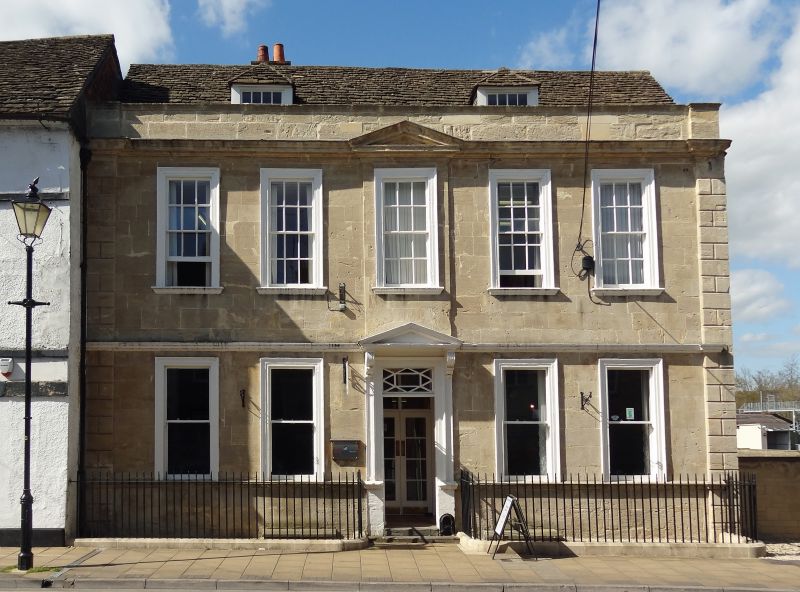
House, now offices. 1702 (deed). Limestone ashlar facade; rubblestone to the rest; Flemish-bond brick turret with burnt headers, freestone quoins and dressings and hipped slate roof; stone slate double-pitched roof with lateral brick stacks to the valley of the main block. PLAN: double-depth central-entry through-passage plan with a turret to rear left and projecting C19 1st-floor closet on cast-iron columns to centre of rear landing. C20 rear extension. The turret may be a former rear stair turret but it is more likely to have been a lobby and entrance to the kitchen and a closet to the 1st floor. EXTERIOR: 2 storeys with attic and cellar; symmetrical 5-window range. The facade has a moulded cornice, sills to 1st floor and sill string course to the ground floor; chamfered rusticated quoins. The central bay is set slightly forward under a small pediment to the centre of the cornice. The painted stone doorcase has a similar pediment on the scroll brackets at string course level. The tall cyma-moulded architrave has a C19 6-panel door and an overlight with coloured triangular panes. Painted moulded architraves to 6/6-pane sash windows to the 1st floor and plate-glass sash windows to the ground floor. The rear has various C18 and C19 windows. INTERIOR: the central axial wall is almost 1m thick and accommodates the stacks that rise from the roof valley. The most complete room is to the front ground-floor left. It has full-height painted pine panelling with a fine box cornice; a white marble fireplace (probably mid/late C18) to the centre of the rear wall with a narrow horizontal panel of grained wood or plaster with richly raised rococo moulding and an animal to the centre; above it is a raised panel with bolection moulding; thick skirting boards and dado rail, all have returned mouldings at the openings; raised-and-fielded panelling to the window shutters, the 8-panel door and the soffits and backs of depressed pointed-arched recesses flanking the fireplace, that to the left has a door to the rear kitchen. Wide pine floorboards. The room to the front ground-floor right, formerly similar, now has a late C19 ornamented cornice and ceiling rose; similar arched recesses without panelling (to the right is a passage to the rear room) flanking a mid C19 white marble fireplace with anthemion motifs to the corners; the original 8-panel door is glazed to the centre; C19 high skirting boards. The central entry hall has late C19 polychromatic tiles; a semicircular arch through the thick central wall has a moulded keystone and archivolt, panelled fronts and soffits and fluted returns. The room to the ground-floor rear right, formerly a kitchen, has a stone Tudor-arched surround and a timber overmantel and cornice to an open fire against the central wall; 2 plastered chamfered crossbeams with run-out stops and a C19 dresser to the left-hand wall still on a flagstone base, other flagstones are removed. Mid C19 8-over-8 pane sash window. The small room to the ground-floor rear to the right of the rear stairwell is altered. The open-well, open-string staircase has a swept skirting, fretted ends and probably C20 thin turned balusters and newel to a wreathed handrail, and raised-and-fielded panelling below and to the 4-panel cellar door. The richly-moulded stairwell cornice has egg-and-dart moulding to the base. Doors to the 1st floor are 6-panel. The room to the 1st-floor front right is partitioned. The rear wall has a returned cyma-moulded cornice to full-height raised-and-fielded panelling with cupboards, flanking an early C19 fireplace. The room to the 1st-floor rear right has 2 boxed-in cross beams and in the rear left corner, steps down to a small closet in the brick turret which has thick glazing bars to a 9/9-pane sash window. The rear 1st-floor closet has painted-over margin panes flanking a C20 door. To the centre front of the landing between the rooms are 2 cupboards, one with a 4-panel door contains winding stairs with oak treads to the extensive attics. Both ranges are 4-bay collar-truss roofs with a central roof connecting front and rear ranges. Some of the tenoned purlins are rough, implying others are later; the collars are nailed. The wide boards, partly covered, are oak or elm. The cellar is approached by stone steps under the stairs, a narrow barrel-vaulted tunnel leads the vaulted area under the front right-hand room. Some original shelves and a cupboard remain against the right-hand wall. SUBSIDIARY FEATURES: the garden to the rear (now occupied by a C20 extension) is enclosed by a stone-coped brick wall (in English Garden Wall bond) attached to the rear. That to the right is a substantial retaining wall approx 40m long, which sweeps up toward the end with a door and steps to the land outside which is approx 2m lower. The facade is of a similar design to No.19 (qv).
Listing NGR: ST9222673304
External links are from the relevant listing authority and, where applicable, Wikidata. Wikidata IDs may be related buildings as well as this specific building. If you want to add or update a link, you will need to do so by editing the Wikidata entry.


Other nearby listed buildings