Latitude: 51.8069 / 51°48'24"N
Longitude: -0.0579 / 0°3'28"W
OS Eastings: 533995
OS Northings: 213809
OS Grid: TL339138
Mapcode National: GBR KBK.Q60
Mapcode Global: VHGPG.YV87
Plus Code: 9C3XRW4R+PV
Entry Name: Gauge House at the River Lee at Ngr TL 3399 1381
Listing Date: 9 September 1996
Grade: II
Source: Historic England
Source ID: 1268987
English Heritage Legacy ID: 461235
ID on this website: 101268987
Location: East Hertfordshire, SG12
County: Hertfordshire
District: East Hertfordshire
Civil Parish: Hertford
Traditional County: Hertfordshire
Lieutenancy Area (Ceremonial County): Hertfordshire
Church of England Parish: Hertford All Saints
Church of England Diocese: St.Albans
Tagged with: Architectural structure
HERTFORD
TL3313NE THE NEW RIVER 817-1/6/347 Gauge House at the River Lee at NGR TL 3399 1381
II
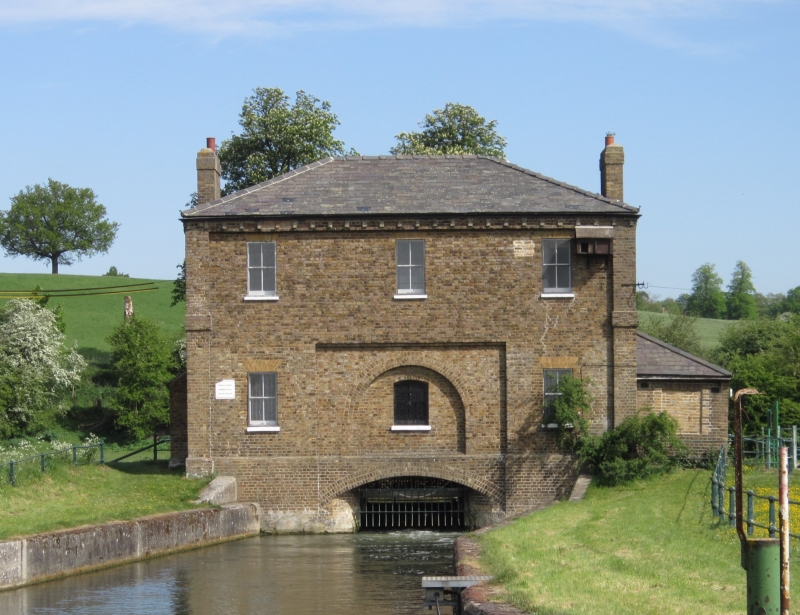
Gauge house with former dwelling house of gauge keeper above. 1856. Constructed by the New River Company, William Chadwell Mylne, Architect and engineer. Yellow-brown stock brick, English bond, Welsh slated hipped roof with brick chimneys with projecting bands. EXTERIOR: 2 storeys above brick-arched bridge undercroft. First floor has 3 recessed plain glazed sash windows, with rubbed brick flat arches above, ground floor has recessed sash windows left and right with pilasters at corners and deep plat band at first-floor level except on south elevation. This has recessed storey height central panel, with inner arched recess, with triple semicircular header arches and central pierced moulded patterned cast-iron grille. Projecting brick segmental header arches forming bridge over central water inlet from River Lee to the New River. North elevation faces River Lee with 3 first-floor sash windows and blank ground floor below plat band. Canted intakes project into the river at ground level. INTERIOR: ground floor contains the gauge which measures the intake of water from the River Lee; it consists of 2 iron boats 5m long floating at Lee level which are joined by a chordal segmental iron beam 9m long, and the rise and fall with the level of the Lee controls the flow of water over the sluice which can be further adjusted by weights hung from the gate, the daily intake from the Lee being 22 1/2 million gallons. The New River runs between stone and concrete abutments. HISTORICAL NOTE: pumping stations were constructed mid C19 to assist the flow, the nearest being at Broadmead close to Chadwell Spring, the original source of supply, 1 1/2 miles east on the outskirts of Ware. The New River was constructed in 1608-13 by Sir Hugh Myddelton to provide water for London, with a 38 mile water course from Chadwell Spring between Ware and Hertford. By early C18 the supply had become inadequate. In 1739 a new Act allowed water to be drawn from the River Lea near Hertford, to be measured by gauges, designed by Robert Mylne (1733-1811). The River Lee Act of 1855 gave the New River Company and the East London Waterworks Company the right to take the whole of the Lee water, with the exception of that required for navigation. An improved cut was made across the King's Meads, and a new Gauge House, designed by William Chadwell Mylne (1761-1862) was built in 1856. (The industrial archaeology of the British Isles: Branch Johnson W: Industrial Archaeology of Hertfordshire: Newton Abbot: 1970-: 97-101 167; Thames Water: History of the New River: London: 1985-).
Listing NGR: TL3399513808
External links are from the relevant listing authority and, where applicable, Wikidata. Wikidata IDs may be related buildings as well as this specific building. If you want to add or update a link, you will need to do so by editing the Wikidata entry.


Other nearby listed buildings