Latitude: 53.0146 / 53°0'52"N
Longitude: -1.903 / 1°54'10"W
OS Eastings: 406602
OS Northings: 346375
OS Grid: SK066463
Mapcode National: GBR 374.ZNM
Mapcode Global: WHBCY.QHZ8
Plus Code: 9C5W237W+VQ
Entry Name: Catholic Church of St Wilfrid
Listing Date: 3 January 1967
Grade: II
Source: Historic England
Source ID: 1037904
English Heritage Legacy ID: 275076
ID on this website: 101037904
Location: Cotton, Staffordshire Moorlands, Staffordshire, ST10
County: Staffordshire
District: Staffordshire Moorlands
Civil Parish: Cotton
Traditional County: Staffordshire
Lieutenancy Area (Ceremonial County): Staffordshire
Church of England Parish: Oakamoor Holy Trinity
Church of England Diocese: Lichfield
Tagged with: Building
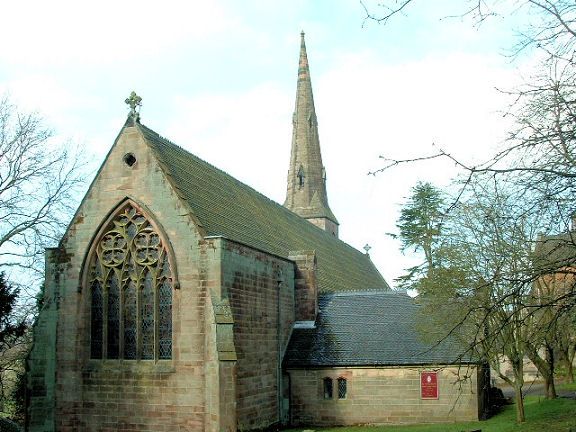
COTTON C.P. COTTON SK 04 NE 4/80 Catholic Church of St. Wilfrid 3/1/67 GV II Roman Catholic Church. 1846-8 by Augustus Welby Northmore Pugin with additions of 1936-7 by George Drysdale. Ashlar; plain tile roof with fish scale tile bands. A Gothic style of circa 1300; south-west tower, 8- bay nave with south aisle, 2-bay chancel of 1936-7 and north-east vestry with extension of 1936-7. South-west tower: 3 stages with broach spire and angle buttresses, the stages are marked by roll and fillet moulded strings, the first and second stage windows have trefoiled arches and hood moulds terminating in heads, pointed belfry windows with 2 trefoiled ogee-arch lights with supermullions and a single reticulation over, continuous roll and fillet moulded dripstone; stair turret at north-west angle with rectangular loops, pointed south door with roll and fillet hood mould terminating in heads, approached by a flight of stone steps. Nave: pointed windows with 2 trefoil-headed lights and cusped Y-tracery, hood moulds terminating in heads, buttress at each bay division and diagonal buttresses to the west corners, west window of 4 trefoil-headed lights and Y-tracery containing quatrefoils, roll and fillet hood mould terminating in heads; pointed west door of 3 roll and fillet moulded orders with foliated capitals to the nook shafts. South aisle: south windows of 3 lights with intersecting tracery containing trefoils and quatrefoils, east window has 3 lights and Geometric tracery. Chancel: pointed windows of 2 trefoil-headed lights and reticulated tracery, east window of 5 lights, 3 with trefoiled heads and 2 with cinque- foiled heads, intersecting tracery containing quatrefoils. Vestry: 1846-8 with addition of circa 1936-7, original vestry is of 2 bays with central pointed door flanked by paired lights; extension to the east with hipped roof and north window of 6 lights all with segmental pointed heads. Interior: austere. South arcade has double chamfered pointed arches on cylindrical columns with foliated capitals; high pointed chancel arch on engaged semi-octagonal columns with moulded capitals and bases; scissor braced naive roof; panelled chancel ceiling. Fittings: good reredos, 5 pointed arches with Y-tracery. Stained glass: good glass in the south aisle of various dates, from the west: 1880-90, St. Bernard; 1949 Teresa of Avila and St. John; 1943, St. Francis; Saint Peter, Mary, and Andrew probably by Hardman; 1885-97, crucifixion; east window of aisle dated 1936. B.O.E. p. 109.
Listing NGR: SK0660246375
External links are from the relevant listing authority and, where applicable, Wikidata. Wikidata IDs may be related buildings as well as this specific building. If you want to add or update a link, you will need to do so by editing the Wikidata entry.


Other nearby listed buildings