Latitude: 51.4471 / 51°26'49"N
Longitude: -2.6008 / 2°36'2"W
OS Eastings: 358345
OS Northings: 172188
OS Grid: ST583721
Mapcode National: GBR C6N.S2
Mapcode Global: VH88M.VWYH
Plus Code: 9C3VC9WX+VM
Entry Name: Fairbairn Steam Crane
Listing Date: 18 February 1972
Last Amended: 2 June 2025
Grade: II*
Source: Historic England
Source ID: 1202666
English Heritage Legacy ID: 380798
Also known as: Fairbairn Crane, Bristol Harbour
ID on this website: 101202666
Location: Canon's Marsh, Bristol, BS1
County: City of Bristol
Electoral Ward/Division: Hotwells and Harbourside
Parish: Non Civil Parish
Built-Up Area: Bristol
Traditional County: Somerset
Lieutenancy Area (Ceremonial County): Bristol
Church of England Parish: St Mary Redcliffe with Temple, Bristol and St John the Baptist, Bedminster
Church of England Diocese: Bristol
Tagged with: Fairbairn steam crane Architectural structure
High-capacity, steam-powered crane, 1876/77-1878, designed by William Fairbairn and constructed by Stothert and Pitt of Bath.
High-capacity, steam-powered crane, 1876/77-1878, designed by William Fairbairn and constructed by Stothert and Pitt of Bath.
PLAN: the crane stands on a semi-circular outcrop of masonry, keyed into the harbour wall (listed at Grade II).
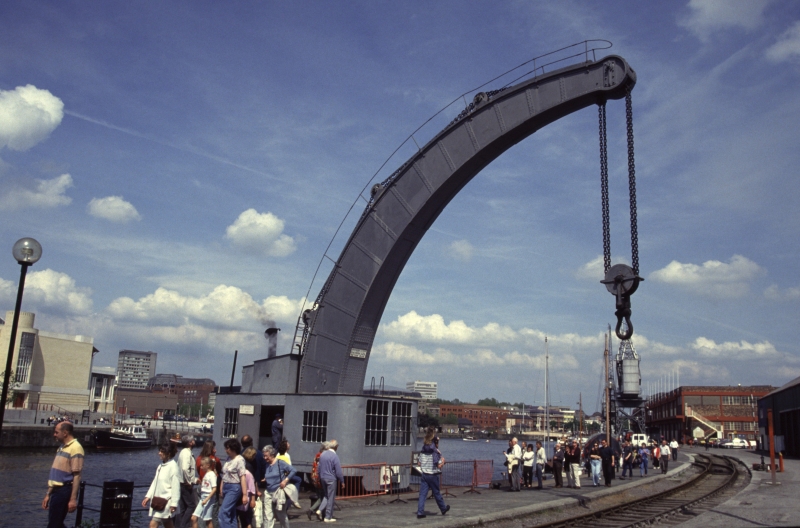
DESCRIPTION: the crane consists of a curved jib and post formed from a continuous box-section girder, mounted with a deep well foundation. A ground-level cab encloses the machinery.
The foundation of the crane is a cylindrical well, formed by a stack of four cast iron rings, restrained by wrought iron ties rods with anchor plates embedded into the quayside. Masonry is built up around the well, forming a semi-circular outcrop from the harbour wall. At the base of the well is a cast iron plate with a bearing for the jib post. At the level of the quayside is a ground ring with 28 cast iron rollers supported on eight vertical rollers, maintaining verticality and enabling the crane to rotate, or slew.
The main structural member of the crane is a riveted wrought iron box girder forming the tapering foundation post and continuing upwards as the curved jib. At its base in the bottom of the well is a bronze bearing which carries the whole weight of the crane. At its head, the jib has two pulley wheels over which the chain runs, with three cast iron rollers bolted to the back of the jib to support the chain. Fixed ladders and handrails were added to the jib at some point between 1926 and 1929.
The cab is constructed from rivetted plates of wrought iron, with generous fenestration in multi-light, cast iron frames with decorative bosses. When built, the cab did not enclose the upper winding drum and boiler top, but by 1928 an extension had been added to improve weather protection. This upper extension was scrapped during the 1970s restoration work, but reinstated in 1989. A number of side panels and butt plates have been completely replaced, identifiable by their bolt fixings. Other panels were repaired by welding in fillets and patches. On the front of the jib just above cab, is a cast iron plate that reads ‘Stothert & Pitt. Engineers Bath. 35 Tons Crane’.
The cab encloses the machinery. Two pairs of engines enable simultaneous lifting and slewing, and there is hand gear enabling occasional lifts when not in steam. The boiler, by Marshall & Sons, was installed in 1953. The jib supports two small cylinders, slewing gear, main lifting cylinders, gear train, winding drums and brackets, and the chassis. The chassis carries the water tank, donkey engine, coal bunker, floor and cab. All castings and gear wheels carry Stothert and Pitt's initials, except the three steps into the cab which bear the name of St Pancras Ironworks, London.
A high-capacity crane was erected on Prince’s Wharf in 1876/1877-1878 to the designs of William Fairbairn, modified and constructed by Stothert and Pitt.
Fairbairn had patented his design for a high capacity crane in 1850. Using a curved box girder of rivetted wrought iron plates, he created a structure of great strength, with the convex top-side holding the tension and the concave underside resisting the compression. The curved form of the jib had the advantage of an unimpeded reach over the sides of ships. The design, which was shown at the Great Exhibition of 1851, quickly took off, and, as a heavy-lift crane, had little competition until some decades later.
While aspirations for a high-capacity crane had been expressed by Bristol’s Docks Committee since the late 1850s, it was not until the 1870s that assent was given. A heavy-lift crane was proposed on Wapping Wharf, where the GWR were working with the Docks Committee to install the Harbour Railway. Docks Engineer Thomas Howard commissioned crane makers Stothert and Pitt of Bath to build a Fairbairn-type crane, with a capacity of 35 tonnes. Work began in late 1875 or early 1876, and test lifts were successfully completed in August 1878. The cost, exclusive of the foundations and cab, was £3,600.
Records do not exist for the use of the crane after its construction, though it is assumed to be infrequent, steamed only for the occasional load which exceeded the capacity of the other, nimbler, cranes on the docks. Howard’s successor, John McCurrich, reviewed the docks’ crane provision in around 1890, recommending dismantling or heightening the Fairbairn crane due to its inability to reach into large vessels; this was not implemented. The installation of an 18 tonne capacity, fixed-jib crane opposite, on Canons Marsh, meant the Fairbairn was only used occasionally. Records survive from the turn of the century, and show that in that first decade the annual use of the crane ranged from zero to 64 lifts. The busiest period in the crane’s history was during the Second World War, when it was used to lift landing craft and harbour service vessels as part of Operation Bedlam.
Bristol’s docks were closed in 1975. While a number of other cranes were sold or scrapped, the historic industrial interest of the Fairbairn Crane was recognised and the structure retained. Responsibility was passed to the City Council’s Arts and Leisure Committee, and allocated to the Museums Service.
Maintenance, repair and replacement of components are part of the life of mechanical structures. The present boiler was installed in 1953, and the chain and block renewed in 1966. A programme of works was undertaken in 1976-1978, including the removal of the upper section of the cab; the fabrication of window shutters; the repair and replacement of the worst corroded cab panels; and the refurbishment of the boiler feed pump. In 1988-1990 a volunteer team undertook a full overhaul of the moving parts of the steam engines and the boiler; the chain was removed and cleaned; a new upper section of the cab was fabricated and installed; and various other repairs to the cab were made. The crane remains operational, and is the only example of a steam-powered Fairbairn type crane to survive internationally.
Sir William Fairbairn, 1st Baronet of Ardwick FRS (1789-1874) was a Scottish engineer, industrialist and inventor. Possessing a clear mechanical aptitude from an early age, he was apprenticed as a millwright, and then had a series of companies, beginning with milling engines and equipment, and later, ship building, railway locomotives, and boilers. He conducted pioneering work in the field of metal strength and stress testing, and his innovative work on box section girders was utilised by Stephenson on the bridges at Conwy, and crossing the Menai Strait, North Wales, and the principles were adopted for the jib of his heavy-lift crane. Fairbairn was the third President of the Institution of Mechanical Engineers, after the Stephensons. Two other hand-powered examples of the crane are understood to survive in England, at Trinity House Wharf, Hull, and Wellington Dock, Dover.
Stothert and Pitt Ltd, ‘crane-makers to the world’, was an internationally renowned and pioneering firm founded in Bath by ironmonger George Stothert (1755-1818) in 1785. Stothert moved to Bath from Shropshire where he had close contacts with Abraham Darby's Coalbrookdale Company. As Stothert’s firm became established it developed a reputation for heavy engineering, particularly the design and construction of dockside and offshore cranes. Cranes produced by the company survive throughout the world, particularly within the former Empire. In England, a number of Stothert and Pitt cranes are listed including the group of four C20 travelling electric cranes nearby on Prince’s Wharf, Bristol (Grade II); the Giant Crane at the former NEM Works, Wallsend, North Tyneside (Grade II*); and a group of 14 at the Royal Victoria Docks, Newham (Grade II).
The Fairbairn Steam Crane is listed at Grade II* for the following principal reasons:
Architectural interest:
* a characterful industrial structure with distinctive curved box-girder jib and sheet-metal cab;
* an application of Fairbairn’s innovative work on box girder technology which produced a crane with a capacity unrivalled for some decades;
* a rare example of a Fairbairn crane, and unique, internationally, as the only surviving steam-powered type, which remains operational.
Historic interest:
* the only steam-powered Fairbairn crane in working order internationally;
* a rare survival of a specialist high-capacity cargo handling structure, and a reminder of the important industrial function of the Docks, upon which Bristol’s prosperity was founded;
* an example of the output of Stothert and Pitt of Bath, leaders in the industry in the C19 and C20, internationally.
Group value:
* with the other cranes around the docks, particularly the C20 Stothert and Pitt electric cranes to the east; the hand cranes at Mud Dock and Redcliffe Wharf; and the crane base at Canon’s Marsh;
* with the listed harbour walls, and the numerous other historic structures in this important area of the City Docks with which the cranes have a strong visual and historical relationship.
External links are from the relevant listing authority and, where applicable, Wikidata. Wikidata IDs may be related buildings as well as this specific building. If you want to add or update a link, you will need to do so by editing the Wikidata entry.


Other nearby listed buildings