Latitude: 52.9365 / 52°56'11"N
Longitude: -1.1963 / 1°11'46"W
OS Eastings: 454110
OS Northings: 337983
OS Grid: SK541379
Mapcode National: GBR LCW.0G
Mapcode Global: WHDGY.LGJ4
Plus Code: 9C4WWRP3+JF
Entry Name: Trent Building, University of Nottingham
Listing Date: 30 November 1995
Grade: II
Source: Historic England
Source ID: 1247539
English Heritage Legacy ID: 457109
ID on this website: 101247539
Location: Dunkirk, Nottingham, Nottinghamshire, NG7
County: City of Nottingham
Electoral Ward/Division: Wollaton East and Lenton Abbey
Parish: Non Civil Parish
Built-Up Area: Nottingham
Traditional County: Nottinghamshire
Lieutenancy Area (Ceremonial County): Nottinghamshire
Church of England Parish: Lenton
Church of England Diocese: Southwell and Nottingham
Tagged with: University building
NOTTINGHAM
SK53NW EAST DRIVE 646-1/6/200 (North side) Trent Building, University of Nottingham
GV II
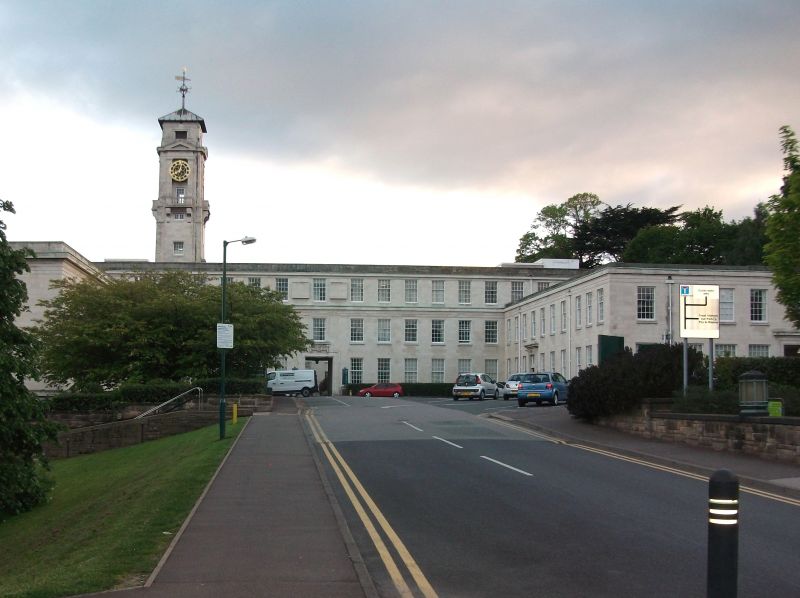
Educational building, now university. 1922-28. By Morley Horder for the University College of Nottingham. Site provided by Sir Jesse Boot of Nottingham. Portland stone with copper roofs. Classical Revival style. EXTERIOR: ground floor string course, main and attic cornices, coped parapets. Windows are mainly original glazing bar sashes. Symmetrical composition with central block recessed between wings and topped by a tall clock tower. 2 storeys plus basement and attics; 7:17:7 windows. H-plan, with central quadrangle flanked to east and west by open-ended courtyards. In the centre, a projecting portico, 3 windows, with pediment containing a crest. Cross-casement French windows to basement and ground floor. Above the portico, the square bell tower with angle pilasters and pyramidal roof with wind vane. On the middle stage, pedimented aedicules and clock faces. Side wings, 2 storeys plus basement, are divided by giant pilasters, doubled at the corners. East wing has an extended basement, 7 windows. In the quadrangle, under the tower, the projecting main entrance, with a round-arched opening, 2 storeys, containing a moulded ashlar doorcase with a Diocletian window above. Over it, a tripartite attic window, and a flat gable with a large datestone, 1928, and Latin inscription. The other sides have regular fenestration and central doors. East courtyard has regular fenestration on each side, with central doorways to east and north. Similar west courtyard, flanked on north and south by single storey ranges. INTERIOR has stone panelled lobby, entrance hall, and corridors on each floor. Entrance hall has moulded cross beam ceiling on 4 granite Doric columns. East wing has a concrete open well stair. Adjoining library, 2 storeys, has panelled ceiling with skylights and cross beams. Largely intact original fittings including wooden screens and balconies in each bay. West wing has Great Hall, 2 storeys, marble clad, with panelled cross beam ceiling. Arcades, 7 bays, with square piers, galleries, and central doors. Coved ends, one with stage, the other with organ gallery. (The Buildings of England: Pevsner N: Nottinghamshire: London: 1979-: 256-257).
Listing NGR: SK5411037983
External links are from the relevant listing authority and, where applicable, Wikidata. Wikidata IDs may be related buildings as well as this specific building. If you want to add or update a link, you will need to do so by editing the Wikidata entry.


Other nearby listed buildings