Latitude: 53.191 / 53°11'27"N
Longitude: -2.8918 / 2°53'30"W
OS Eastings: 340514
OS Northings: 366358
OS Grid: SJ405663
Mapcode National: GBR 7B.2S3Q
Mapcode Global: WH88F.K261
Plus Code: 9C5V54R5+97
Entry Name: 15 and 17 Northgate Street
Listing Date: 10 January 1972
Last Amended: 6 August 1998
Grade: II
Source: Historic England
Source ID: 1376340
English Heritage Legacy ID: 470335
ID on this website: 101376340
Location: Chester, Cheshire West and Chester, Cheshire, CH1
County: Cheshire West and Chester
Electoral Ward/Division: Chester City
Parish: Non Civil Parish
Built-Up Area: Chester
Traditional County: Cheshire
Lieutenancy Area (Ceremonial County): Cheshire
Church of England Parish: Chester, St Peter
Church of England Diocese: Chester
Tagged with: Building
This list entry was subjected to a Minor Enhancement 11 December 2024 to Update Name, Address and Details, add Selected Sources and reformat the text to current standards
SJ4066SE
595-1/4/280
CHESTER CITY (IM)
NORTHGATE STREET
Nos. 15 and 17
(Formerly listed as NORTHGATE STREET AND ROW (West side) Nos.15 & 17 Street, previously listed as NORTHGATE STREET (West side) Nos 15 & 17 Row)
10/01/72
GV
II
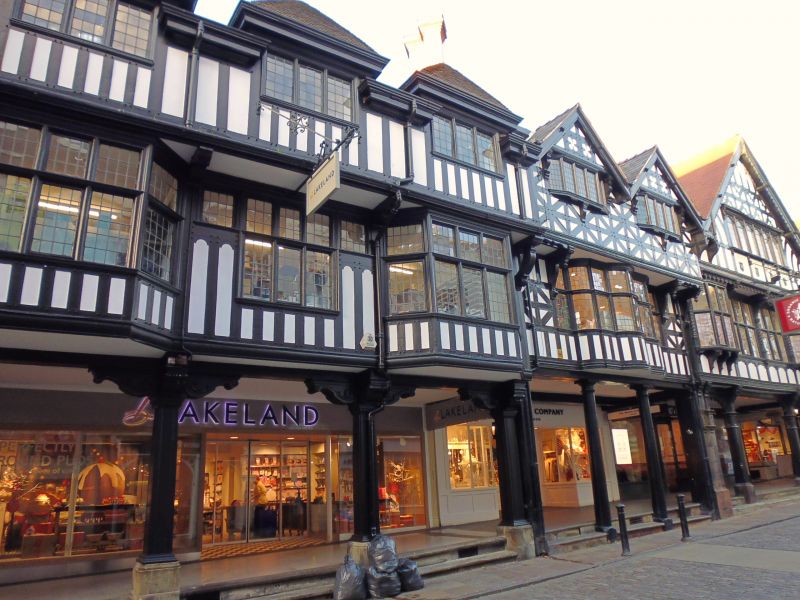
15 and 17 Northgate Street was built in 1909 as a shop with storage above as part of the reconstruction of a group of buildings known as ‘Shoemakers’ Row’ (3 to 31 Northgate Street) between 1897 and 1909. The redevelopment of the Row was prompted by concerns over insanitary conditions in the congested Northgate area, alongside a renewed interest in the vernacular style, and was carried out as part of a municipal road widening project at the end of the C19. It was designed by the architect James Strong in the Vernacular Revival style. Strong was a pupil of the prolific Chester architect John Douglas and went on to be City Architect for Chester Corporation, designing the fire station on Northgate Street in 1911. The new building was constructed on the site of the Cross Keys Inn and incorporated a pair of short sandstone undercrofts which probably belonged to a single medieval townhouse. The rebuilding of Shoemakers Row lowered the ‘Row’ element of the building to just above street level and the medieval undercrofts survive below the street level and operate as cellars. The building has some concealed metal framing and is timber framed with plaster panels and a clay tile roof.
EXTERIOR: the building is of three storeys above a pair of joined medieval undercrofts.
The Row is at ground level and is two steps above the pavement. It has an arcade with four stanchions concealed within painted timber hollow posts with Classical mouldings to their heads and feet. The posts sit on yellow ashlar piers and carry a bressumer to the jettied second storey on moulded timber brackets to the front and sides.
The second storey is of three bays and has close-studded timber framing beneath continuous leaded glazing, a five-light oriel window with moulded mullions and transoms to each side bay and a three-light mullioned and transomed casement window with a fixed light to each side above transom level, to the middle bay.
The third storey is jettied, with close-studded timber framing. There are three hipped half-dormers with windows of three lights with moulded mullions and rainwater hoppers with cornices. To each end of the roof ridge is a red brick chimney with a stone plinth and two diagonal flues with corbelled brick caps. The rear elevation is brick.
INTERIOR: the short undercrofts were probably the paired undercroft of one medieval house and there are the remains of a stair leading from the undercroft of 17 Northgate Street to the Row of number 15. An earlier pit, probably Roman, is located by the north wall of number 17. The second storey has a plaster cornice in the front room and the broad openwork arches of two former arcades from which the posts have been removed.
Listing NGR: SJ4051466358
External links are from the relevant listing authority and, where applicable, Wikidata. Wikidata IDs may be related buildings as well as this specific building. If you want to add or update a link, you will need to do so by editing the Wikidata entry.


Other nearby listed buildings