Latitude: 51.9938 / 51°59'37"N
Longitude: -2.1536 / 2°9'12"W
OS Eastings: 389552
OS Northings: 232823
OS Grid: SO895328
Mapcode National: GBR 1JK.VS9
Mapcode Global: VH93T.M4CX
Plus Code: 9C3VXRVW+GH
Entry Name: North East Terrace Oldbury Cottage
Listing Date: 31 October 1989
Last Amended: 25 April 1994
Grade: II
Source: Historic England
Source ID: 1206048
English Heritage Legacy ID: 376739
ID on this website: 101206048
Location: Tewkesbury, Gloucestershire, GL20
County: Gloucestershire
District: Tewkesbury
Civil Parish: Tewkesbury
Built-Up Area: Tewkesbury
Traditional County: Gloucestershire
Lieutenancy Area (Ceremonial County): Gloucestershire
Church of England Parish: Tewkesbury Holy Trinity
Church of England Diocese: Gloucester
Tagged with: Cottage
TEWKESBURY
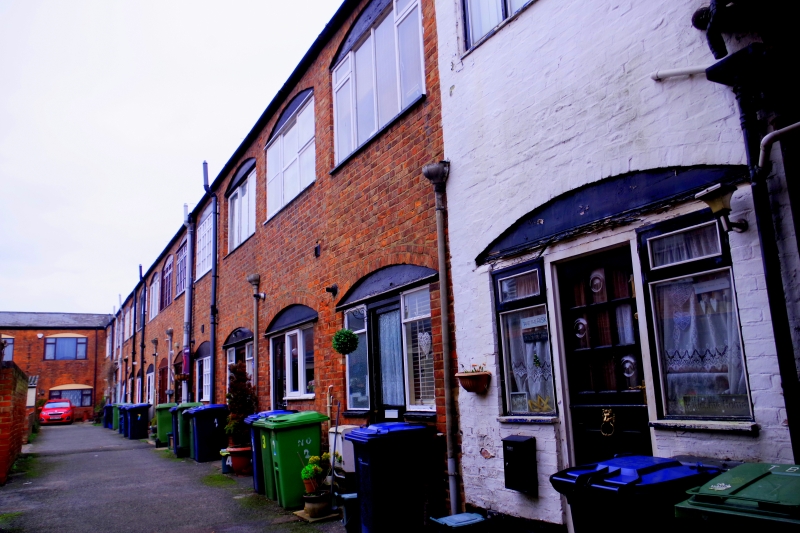
SO8932 EAST STREET 859-1/6/158 (North side) 31/10/89 (Consecutive) Nos.1-16 North East Terrace and Oldbury Cottage (Formerly Listed as: EAST STREET (North side) Nos.14, 16, 17 AND 18 1-16 (Cons) NE Terrace inc Oldbury Cottage and dwelling adj to E)
GV II
Terrace of 16 houses, formerly lace and stocking-knitting factory. Originally built 1825 for George Freeman, lace manufacturer, enlarged c1860 for Samuel Massey Crosse, converted to houses c1900. Modified English garden wall bond brickwork, slate roof, brick stacks. PLAN: a long building with repetitive detail set at right angles to East Street, and approached through a wide carriage arch between Nos 16 & 17, East Street (qv). A short wing returns across the far end, including Oldbury Cottage, backing on to Trinity School Walk. EXTERIOR: 2 storeys with attic, 15-windowed to west and 16 to east. Varied casements, mainly 3-light, all to wide segmental-headed openings at both levels, with narrow brick piers between bays. Doors form part of fill to ground floor archway, with filled tympana. At the back (E) a similar series of arched openings at 2 levels, with small sky-lights to roof, and small 1-storey extensions. 16 square brick ridge stacks each with 4 square cream terracotta pots. Factory extended across N end and returned to S in 1860. The N gable retains, at first floor, 2 of the wide windows with original small-pane glazing. INTERIOR formerly very austere with no internal columns (see VCH), since c1900 completely divided into separate dwellings. HISTORICAL NOTE: this was the first and largest textile factory in Tewkesbury, built to accommodate 37 transverse warp bobbin net machines. Freeman came to Tewkesbury from Nottingham to take advantage of the skills in the local stocking industry. Steam had been introduced by the mid 1830s but in 1853 Freeman retired, and the factory remained empty until 1860 when Samuel Massey Crosse from London enlarged the buildings and installed power looms driven by a 12hp Edwards Beam Engine which also provided central heating. Crosse's company was called 'The Patent Renewable Hosiery Company', but he died in 1860 and the factory closed; re-opened in 1862, by about c1900 it was finally closed, and converted to houses. The stocking knitting industry, which had increasingly taken the place in the C17 and C18 of the declining wollen cloth industry, had become the chief industry of Tewkesbury by the early C19: in 1830 700 frames employed 1/4 of the population. With the various terraces of workers' cottages in East Street and Chance Street the whole area stands as an important reminder of Tewkesbury's recent industrial past. (Adcock J A: The Tewkesbury Stocking Industry: 1760-1900: 1973-; Victoria County History: Gloucestershire: London: 1968-: 145).
Listing NGR: SO8955232822
External links are from the relevant listing authority and, where applicable, Wikidata. Wikidata IDs may be related buildings as well as this specific building. If you want to add or update a link, you will need to do so by editing the Wikidata entry.


Other nearby listed buildings