Latitude: 53.7109 / 53°42'39"N
Longitude: -1.2443 / 1°14'39"W
OS Eastings: 449978
OS Northings: 424100
OS Grid: SE499241
Mapcode National: GBR MTRJ.FG
Mapcode Global: WHDC1.VZNH
Plus Code: 9C5WPQ64+97
Entry Name: Church of St Botolph
Listing Date: 18 December 1963
Grade: II
Source: Historic England
Source ID: 1225755
English Heritage Legacy ID: 422264
Also known as: St Botolph's Church, Knottingley
St. Botolph's Church, Knottingley
ID on this website: 101225755
Location: St Botolph's Church, Knottingley, Wakefield, West Yorkshire, WF11
County: Wakefield
Electoral Ward/Division: Knottingley
Parish: Non Civil Parish
Built-Up Area: Knottingley
Traditional County: Yorkshire
Lieutenancy Area (Ceremonial County): West Yorkshire
Church of England Parish: Knottingley St Botolph
Church of England Diocese: Leeds
Tagged with: Church building
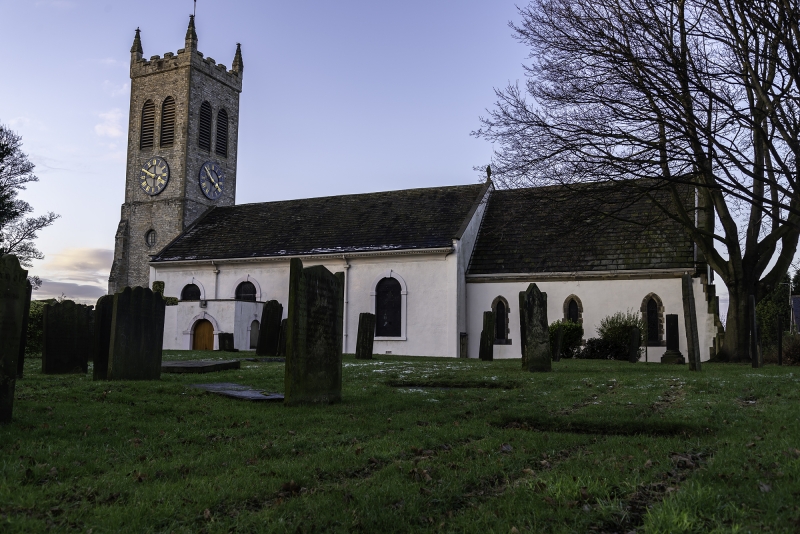
KNOTTINGLEY CHAPEL STREET SE42SE (west side) 5/33 Church of St. Botolph 18.12.1963 GV II Parish church. 1750 rebuild of Norman chapel, with west tower added 1873, chancel rebuilt 1886. Magnesian limestone (nave and chancel both rendered), stone slate roofs. West tower, nave with south porch, chancel. Rectangular 4-bay nave in simple classical style has round-headed windows with imposts and keystones, and 2nd bay has a square flat-roofed porch beneath the window, with similar round-headed outer doorway and side-wall windows. Four-stage tower with angle-buttresses to 1/2-height and set-back upper stages has in each side a single lancet to the 1st stage, a circular window to the 2nd, a large clock face to the 3rd, a pair of louvred lancets to the belfry stage, and an embattled parapet with corner pinnacles. Three-bay chancel has lancets, and a 2-centred arched east window of 3 lights with bar tracery and a wheel in the head. Interior: C18 nave is a single vessel with wide round-headed chancel arch (and was formerly galleried at the west end and north sides); west wall incorporates the deeply-splayed reveal of a blocked round-headed Norman window surviving from the narrower former chapel (see History). Numerous wall monuments including: in north wall of chancel, a sandstone tablet to William Savile of Criddleing Park (d.1691) with pedimented aedicule, a carved, bird in the pediment, incised skull-and-crossbones in each corner, and full inscription (in Latin); in south wall of chancel, 2 marble tablets with pedimented aedicules (i) to Arthur Ingram (d.1733) with painted inscription (ii) to Revd. Mr. Goodricke Ingram, Fellow of Trinity College Cambridge, (d.1755), with broken pediment, each pediment surmounted by a coat of arms; in round-headed panels between windows in south wall, 2 obelisk wall monuments (i) to Lydia, wife of John Banks (d.1792), with bas-relief urn on the obelisk, and (ii) to Ann, daughter of John Banks and Lydia his wife (d.1781), with bas relief of child weeping over urn. History: built by Henry de Lacy, lord of the manor, c.1150, as chapel of ease to All Saints, Pontefract; rebuilt in C18, with endowments of Ingram family of Temple Newsam (then lords of the manor of Knottingley); galleries and box pews removed in 1887.
Listing NGR: SE4997824100
External links are from the relevant listing authority and, where applicable, Wikidata. Wikidata IDs may be related buildings as well as this specific building. If you want to add or update a link, you will need to do so by editing the Wikidata entry.


Other nearby listed buildings