Latitude: 53.1883 / 53°11'17"N
Longitude: -2.891 / 2°53'27"W
OS Eastings: 340560
OS Northings: 366060
OS Grid: SJ405660
Mapcode National: GBR 7B.308H
Mapcode Global: WH88F.K4K3
Plus Code: 9C5V54Q5+8H
Entry Name: Falcon Inn
Listing Date: 28 July 1955
Last Amended: 6 August 1998
Grade: I
Source: Historic England
Source ID: 1376292
English Heritage Legacy ID: 470287
Also known as: Falcon Inn, Chester
ID on this website: 101376292
Location: Chester, Cheshire West and Chester, Cheshire, CH1
County: Cheshire West and Chester
Electoral Ward/Division: Chester City
Parish: Non Civil Parish
Built-Up Area: Chester
Traditional County: Cheshire
Lieutenancy Area (Ceremonial County): Cheshire
Church of England Parish: Chester St John the Baptist
Church of England Diocese: Chester
Tagged with: Pub
CHESTER CITY (IM)
SJ4066SE LOWER BRIDGE STREET 595-1/4/230 (West side) 28/07/55 No.6 Falcon Inn (Formerly Listed as: LOWER BRIDGE STREET (West side) No 6 & Nos 8 & 10)
GV I
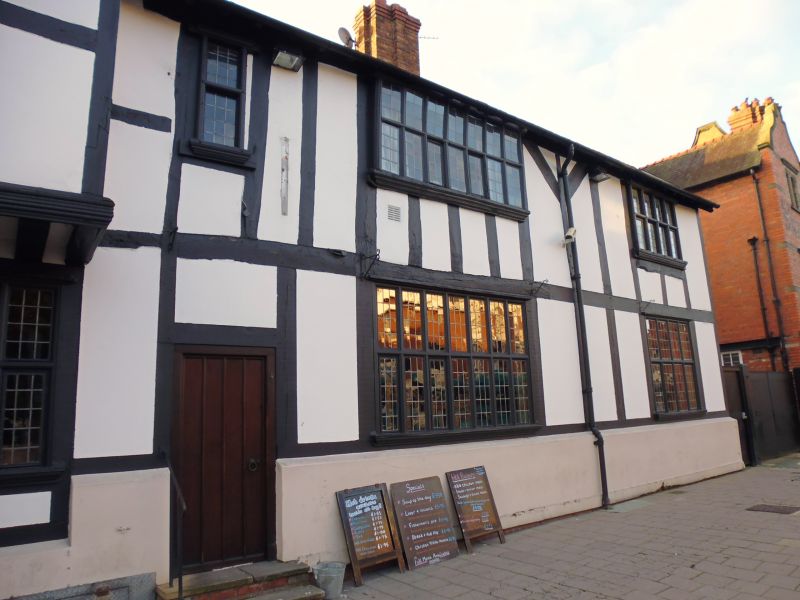
Town house, now a public house. c1180 altered later Middle Ages, C16, 1626 and C20. Coursed rubble sandstone, timber frame with plaster panels, some wattle and daub, and brick; grey slate roofs. EXTERIOR: cellar and 2 storeys of 2 bays to Lower Bridge Street and formerly of 2 spans to Grosvenor Street. Much of the stonework and the timbers from the former east span of the roof, now reused in the cellar ceiling, date from 1180; the timber framing dates from later alterations. The front to Lower Bridge Street has undercroft of coursed red sandstone, mostly now rendered; the storey above containing the now enclosed Row, has close studding with a wide 11-light leaded windows having moulded oak beam and ovolo mullions and transoms. 9 renewed steps to south from pavement to former Row giving access to the bar; repaired medieval stone sidewalls, low 2-centre arch and walls repaired in brick in the porch; a replaced framed and boarded oak door,with massive oak frame, arrises moulded. Dragon-beam on shaped bracket at north-east corner; square oak beams carrying jetty-bressumer with carved fascia; the north-east corner is canted. The second main storey has a row of 12 quatrefoil panels, sloped slightly outward, beneath a continuous 34-light leaded window, returned with a further 6 lights to north face, with hollow-chamfered mullions and transom, moulded corner-post and head-beam jointed at centre; the window is sloped outward. A pair of gables on 3 shaped brackets have moulded ties, herringbone struts, replaced moulded bargeboards and shaped finials. The timber frame is late C16, restored by John Douglas late C19. The face to Grosvenor Street has a higher and older east portion and a lower 2-storey west wing, probably 1626 for Sir Richard Grosvenor. The east portion has sandstone wall to undercroft and Row storey, partly replaced in brick, and a leaded cross-window. A moulded jetty-beam on round-ended beams to the small-framed second storey, with one intermediate rail, two diagonal braces to face and one to the west return, the
return of the continuous window to Lower Bridge Street and a leaded cross window. A shaped lateral chimney of brown brick. The west portion has a rendered plinth, large framing, a leaded 7-light mullioned and transomed window and a similar window of 4 lights. The second storey has large framing, 2 adjacent angled braces and 2 mullioned and transomed casements plus a 1-light transomed window, east. The rendered full-width rear gable-end has nearly-flush 12-pane sashes, one to the first storey and 3 to the second storey. INTERIOR: the medieval undercroft, now beer cellar, has a 2-bay north chamber and a parallel one-bay south chamber, formerly a single 3-bay undercroft. The north cellar has a massive oak central east-west beam on 3 samson posts with arched braces, one removed, on sandstone bases. 2 octagonal stone piers now joined by modern brick wall between north and south cellars; both cellars have outer walls of coursed rubble sandstone, repaired and altered in brick; the north cellar has blocked stone stair to street in east wall and replaced stair west; stone corbels in north wall and medieval joists over east part. The south cellar has medieval window-jamb in east wall, opening with depressed arch of 2 stones to recess with remains of spiral stair in west wall, a cupboard recess in south wall, stone corbels and repositioned medieval joists. Main timbers in the cellars dated c1180 are reused, from a former scissor-braced truss over the east portion of the early medieval town house. The Row storey front room has 2, of possibly formerly 4, sandstone Row piers, chimney breast of stone and brick, north, dragon-beam and joists. The centre room north has corner fireplace, breast shared with front room, framed partitions with one intermediate rail, shared with the south room which has a south wall partly of sandstone. The west wing has a timber-framed south wall and north wall partly of stone. The timber-framed front second storey room has dado panelling and a fluted square cast-iron central column. The centre rooms show some timber framing. (Chester Rows Research Project: Grenville J: Lower Bridge Street West: 1988-).
Listing NGR: SJ4056066060
External links are from the relevant listing authority and, where applicable, Wikidata. Wikidata IDs may be related buildings as well as this specific building. If you want to add or update a link, you will need to do so by editing the Wikidata entry.


Other nearby listed buildings